Episode Transcript
[00:00:00] Speaker A: Can hunters coincide safely in the woods with others who want to be out there recreating as well?
[00:00:06] Speaker B: The majority of hunters and fishers are law abiding and go to great extents to make sure that they are following the laws.
[00:00:15] Speaker C: What does conservation mean to you?
Hello and welcome to Call the Outdoors, the podcast of the Pennsylvania Game Commission.
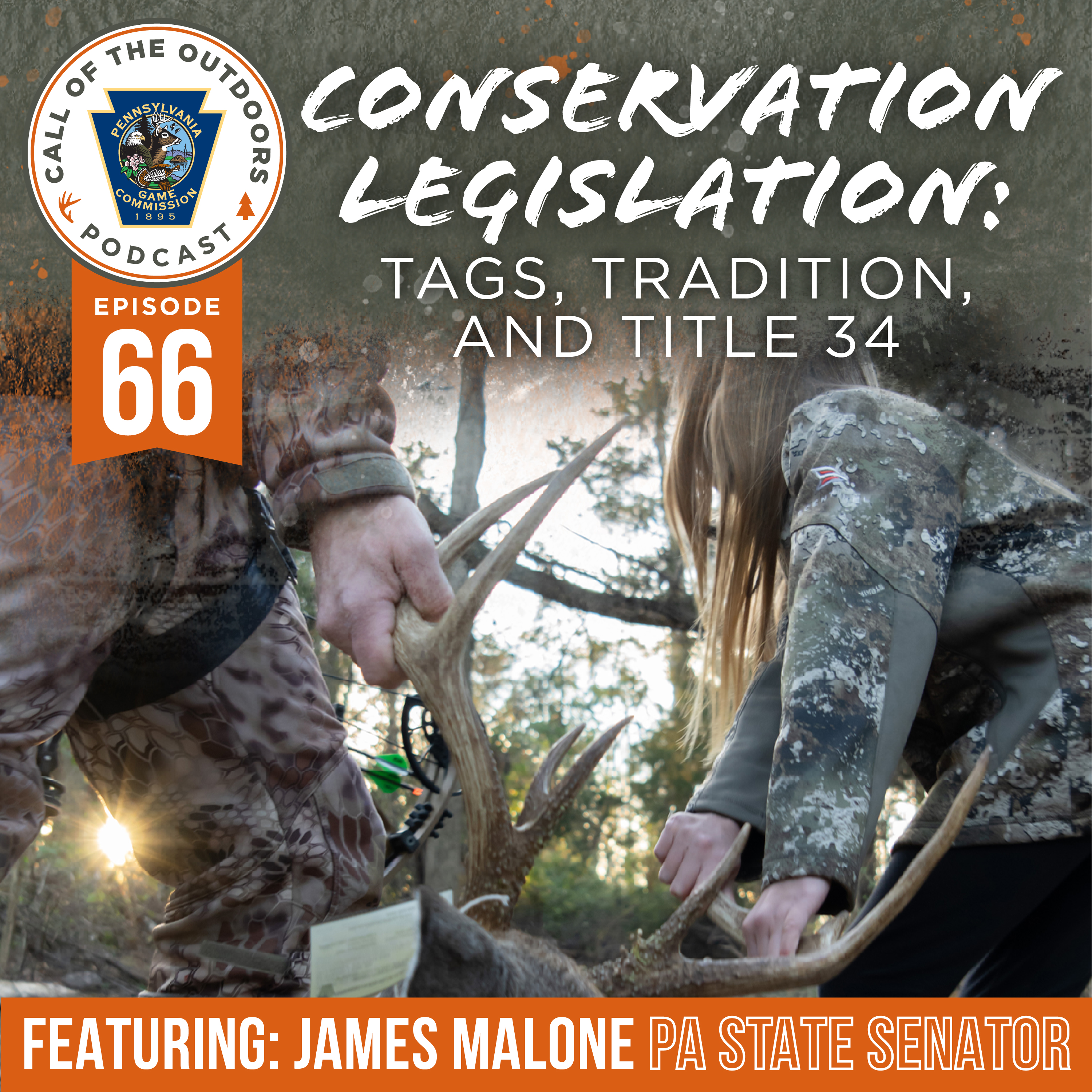
Hope everybody is having a great winter, had a great hunting season. If you got a little cabin fever, don't forget, next week starts the Great American Outdoor show down in Harrisburg. We're going to be there as a game commission. Come see us, come talk to us. We've got a really awesome episode today and we have our executive director, Steve Smith, and also Senator James Malone out of Lancaster County. And we're going to talk a lot about what happens down in Harrisburg as it relates to conservation, the Game Commission, wildlife, and just nature in general. So we appreciate Senator Malone coming on. He's got an incredible bill that he's just introduced, Senate Bill 1142, that's going to allow every graduate of Hunter Trapper Education to receive an Atlas Doe tag. And we're happy with that introduction, but we're going to get right into it and pass it over to Steve.
[00:01:13] Speaker A: Well, good morning. We are fortunate to have with us Senator James Malone. Senator Malone is the minority chair for the Senate Game and Fisheries Committee.
Senator Malone, thanks for joining us today.
[00:01:25] Speaker B: Yeah, absolutely.
[00:01:26] Speaker A: And you stepped into the scene, into the world of Pennsylvania politics and wildlife in a really big way early in 2025. And we'll certainly talk about that in a minute. But to kick things off, why don't you tell us about your background and how it led you to where you are here today.
[00:01:47] Speaker B: Sure, sure. So. Well, I was born and raised in Powell, Wyoming.
And as it relates to game and fisheries, I spent a lot of time out there, hunting, fishing, everything else. And just for reference, Powell, Wyoming is not Wyoming county in Pennsylvania.
[00:02:06] Speaker A: Okay.
[00:02:06] Speaker B: It's the park county in the state of Wyoming, about 93 miles from Eastgate, Yellowstone.
So I literally grew up with Yellowstone national park as my backyard.
But you know, we had a lot of economic instability. My mother had some issues and my maternal grandmother frequently filled in. But in that dynamic, I spent a lot of time outdoors, a lot of hunting, fishing, farming, that nature.
My maternal grandmother had 20 acres out there. I think she got it when I was like five or six. And so we spent a good portion of my youth flattening, scraping, building that land up to raise goats and pigs and cattle. And what happened?
[00:03:06] Speaker A: Have you.
[00:03:07] Speaker B: But yeah, that's Kind of just a general background. And then I ended up going to college down through Tennessee and ended up following different jobs and ended up raising my kids here in Pennsylvania and stepped into politics proper as mayor of East Petersburg Borough.
And then, of course, won that special election in March and stepped into the Senate.
[00:03:40] Speaker A: Right. And I think you told me that growing up with that background, you did a good bit of hunting and fishing, but it was more on a subsistence level than recreational level. Is that right?
[00:03:50] Speaker B: Yeah, that's true.
Even the, like, you know, we'd get some bounties for nuisance hunting.
Magpies, skunks, you know, those kind of things depended on what the local farmers were having trouble with, that kind of thing. And then, of course, you know, rabbit, squirrel, and mule deer as food sources.
I would say I spent a lot of time outdoors and a lot of time hunting, but I didn't really do well.
You know, I can count on one hand how many I actually trapped and, you know, how many kills I actually had.
But whenever we had it, it was good meat and stuff. And I was telling my communications director about going through a couple of different seasons of trying to dry, dehydrate deer meat, and one season, I didn't quite get it dry enough and ended up with very green, very fuzzy batch of jerky.
But, yeah, it's a good experience.
[00:05:10] Speaker C: And when you look at Wyoming, a lot of our hunters from Pennsylvania travel to Wyoming every year when they're lucky enough to draw tags. But when you look at the state of Wyoming and then look at the state of Pennsylvania, we almost have as many licensed hunters as the population in Wyoming. So, I mean, we. When you put that in perspective, hunting is so important to our tradition and who we are in Pennsylvania. But just a little bit about your views on hunting and what hunting means to conservation.
[00:05:38] Speaker B: Absolutely, absolutely. So, again, for me, it's a very important aspect of connecting with nature and of drawing that bounty, whether it's fishing and out here. It was great taking my kids out fishing and stuff like that.
And.
And even the Special Olympics had a fishing derby day.
So myself and a lot of other parents would take our kids out there, and then we would, like, gut the fish and do the cleaning, the hard bat. But, you know, the kids got to have that experience.
But in all of that, it is a way of really connecting with nature and with the roots.
And I think it's something that. I mean, for me, I grew up and took it very seriously simply because it was a very efficient way of gathering meat and another resource for my Family.
But even here in Pennsylvania, if you enjoy the sport, you know, there's share the harvest, there's all these programs that can take that meat and take those resources and redistribute them to folks that really need it. So there's, I think that's awesome in that continuation and I also think that that helps bind a lot of people to that passion of we need to keep our natural resources in abundance and that ends up helping everyone. Whether you love hiking or you love mountain bike or just getting out there with a camera and what have you or just a scenic walk, all of those are benefited by that deep love of getting out and being involved in harvesting from, from nature. Absolutely.
[00:07:42] Speaker C: And we're proud of our hunters here in Pennsylvania and the hunter sharing the harvest program. And just the, you know, that whole program is just a great deal. You know, it helps us with management and it gives us an outlet to help people that, that, that need that high quality protein.
[00:07:58] Speaker A: So coming from that background into Lancaster county, and we know how important everything you talked about is to the residents of Lancaster County. In fact, I believe, and Matt, correct me if I'm wrong, but if the number one county for licenses sold, for hunting licenses sold. So when you we then find yourself in Lancaster county and hear these issues again, they must be familiar with you given that background that you have and how you grew up. Slightly different context. Much more.
[00:08:23] Speaker B: Yeah, I was going to say it's a little bit different context, but yeah, a lot of the line items are the same importance. You know, how do we make sure that we keep our waterways clean? You know, how do we make sure that we're, you know, managing the ecosystem enough that it stays around and it doesn't get overburdened or you know, or just devastated.
You know, throughout our country we have history of over hunting to the point of extinction in certain areas.
But that was a long time ago and we've taken the time to learn from those mistakes and to build up a very good, very rich service, whether it's forestry or the Game Commission.
And I think that is another testament to that conservationist nature moving forward now.
[00:09:25] Speaker A: Yeah, absolutely, you're correct. You know, mistakes were made in the past, but I think we've certainly learned from them. And that's always though in the back of our mind of making, keeping that in mind that it is a resource that could be depleted if not managed properly. And that's how we approach our decision. So with that background, it's a diverse background for sure. You stepped in then to the Senate and to the role of the minority chair in the Senate Game and Fisheries Committee.
Talk to us about your responsibilities in that role and how you're approaching it.
[00:09:57] Speaker B: Sure.
So obviously anyone on the floor gets an idea or learns from constituents and stuff, and they can put forward a proposal for a bill and then based on the judgment of, you know, where that hits better, it'll get pushed into one of the committees. Right. So something lands in Game and Fisheries, it's usually boat related or game related or, you know, fishery related.
And then we try to, obviously, at the discretion of the majority chair, we set up hearings and what have you to discuss, you know, different bills. And then we'll either after that hearing or at a later date, have a vote on, you know, whatever that piece of legislation proposed is.
And so we spend a lot of time talking with the Game Commission, talking with the boat and fish.
I always want to say department, but, you know, commission as well. Yeah, commission.
And, and talking with other people, you know, whether it's Ducks Unlimited or Hunters Unlimited or, you know, the.
Over. We have Lancaster Conservancy over in our area. But we talk to every party involved to try and get a good grip of, you know, is this change or is this new regulation going to do more good than it does harm? Because every time you tweak something, you end up with a little bit that's not comfortable. Right.
But the goal is to try and do the most good, you know, be the most productive.
And then, you know, if, if we get that, well, then, you know, we'll try and, you know, explain that to other folks and why we're doing it and everything. And sometimes it takes a lot of work, you know, to get things aligned. Other times it's a no brainer and people are, you know, immediately on board and you can go forward.
But that's really, it's that, that attempt at gathering all the different views, gathering all the different facts, and then sometimes having to mitigate between people's emotional responses and the actual data.
And then, all things considered, we're able to move something forward.
[00:12:45] Speaker A: Yeah, I think that was a great summary of what that process looks like. And nodding along as you talked about it. And I kind of look at, for the Game Commission's perspective, our power, if you will, our responsibilities, all flow from title 34. Right. That's the statute that created us. It governs us. And we see the committees, be it Gaming, Fisheries in the House or in the Senate, as kind of the gatekeeper to title 34.
As you said, any bill that impacts that statute has to run through those committees. And the chairs then obviously dictate in a large sense how that's going to play out and what it's going to look like moving forward and take into consideration all that input and as you talked about and hearing from stakeholders and that process behind the scenes that goes into it.
[00:13:34] Speaker B: Right.
[00:13:34] Speaker A: And that played out in a. In a very real way again early in 25 with Sunday hunting legislation, which, if I recall correctly, was that your first meeting?
[00:13:47] Speaker B: Yeah, I believe that was my first Game and Fisheries. Game and Fisheries Committee meeting. Committee meeting, yeah. But Senator Rothman and I had talked about it beforehand, and I actually thought it was funny because he came up and he goes, what do you think about Sunday hunting? And I was like, I know it's been a big debate here for a long time. I don't really understand why.
And had that explanation of.
And actually in committee, we had some different debate. And I brought up, you know, growing up out in Wyoming and, you know, being out hunting and realizing that there are hikers and bikers and everything else, and you learn, you know, it's your responsibility to manage your firearm and your field of view and everything out responsibly.
So, you know, you're not out shooting at an ATV driver, you know, the difference between a deer and an atv.
And so it was an interesting discussion because of the history and the way people are used to doing things.
But my big push for the change, and actually, my push for the change exists even before I got in as mayor because, you know, my kids were very active in cheerleading and football and track and field and all these other things. And I'd had friends talk about, oh, hey, we're going to the hunting lodge, you know, and we're going to go here. And it's like, okay, well, I'm not going to be available.
But, you know, it is one of those things that when I started talking to just folks in general after we moved the bill as well, they had a lot of the same experience as I did.
Their parents or grandparents had a lodge up there, and they loved it when they were able to get up there. But their kids are so active that Sunday's literally the only day that they would have to be able to take their kids out and participate.
And so, you know, once I got in and, you know, Rothman asked, and I was already very much on the side of, you know, we should change this and allow.
And it is a bit of a misnomer in the bill overall, because all it does is allow the Commission to set that schedule.
So, you know, if things are going on some season and. And it doesn't really work, they would readjust that schedule.
[00:16:48] Speaker A: You're absolutely correct. And going into that, we had had a chance to talk prior to that vote. And just as sort of aside, we knew that that committee meeting was probably going to be the toughest obstacle that that bill had.
So you and I talked a few weeks prior, and then given it was your first meeting, though, as we went into it, and we're kind of counting all the votes ahead of time, we were very curious, to put it mildly, to see how you would vote on it and if your early support that you told us was going to hold, given how quickly controversial it came and how much it was debated in committee. So I think a lot of us were kind of holding up, waiting with a bated breath as you started to talk about it.
And you hit on those points that you just mentioned, having grown up in a state where hunters coincide with other outdoor recreationists. And it was such a good perspective, I think, that you brought to that discussion because there were some very legitimate safety concerns that other members were bringing up. That's always part of the conversation with Sunday hunting is can hunters coincide safely in the woods with others who want to be out there recreating as well?
And that was kind of driving the debate. And then you spoke, and again, we were kind of all anxiously waiting to see where you were going to be in any committee vote, but particularly one in which it was so close. Right. It was coming down to one vote. All votes mattered, and certainly yours as the newest vote, is where we were looking towards. And then you gave that perspective, talked about you've seen hunters coincide with other outdoor recreationists and that you were comfortable making this vote. And on a very personal level, as soon as you said that, I kind of breathed a sigh of relief.
[00:18:32] Speaker B: I thought he held to his word.
[00:18:33] Speaker A: Like he said he would. I mean, that was a really a great moment.
[00:18:37] Speaker B: One, you know, and I have talked with, like, Representative Maloney. He's got a Y at the end, and I've talked with other folks. And, you know, one of the things that I say as an argument is, look, we've had about 200 years of, you know, the what is now the old way, you know, so give us three to five years of this new cycle, and let's see if it does what we're hoping. Let's see if it increases hunter participation. Let's see if it helps reduce our overpopulation of deer. You know, let's see if it helps with our farm work, trying to reduce the crop decimation and things like that, you know, so.
But you know, three to five cycles, if we get that far out and it's absolutely not working at all, then you know, there's a valid argument to hey, change the schedule. But you don't even have to change legislation at that point because you have the freedom now you can change the schedule.
[00:19:42] Speaker A: Absolutely right. And it is obviously a limited data set. We just had it out for one fall hunting season, 13 Sundays. But we can say as of now that we don't have any reported incidents involving safety accidents with a hunter and a non hunter.
Again, limited data set, but at least the initial year, what we've seen is it kind of validates exactly what you said, that our hunters are going to be able to coexist and share the woods with non hunters. So very encouraging based on what we saw from this first year.
[00:20:12] Speaker B: That's awesome. I hope that continues.
[00:20:16] Speaker C: I gotta ask you a question. Cause I'm sitting here just thinking while y' all are talking about that. So being from Wyoming, in Tennessee and Pennsylvania, like when college football's on on Saturday, who do you root for?
[00:20:27] Speaker B: So my wife is a die hard born and bred Eagles fan. Okay. So I am a fan of a fan.
[00:20:34] Speaker C: I got you.
[00:20:35] Speaker B: Go birds.
[00:20:36] Speaker C: Good answer.
[00:20:37] Speaker B: Next season. Next season. Apparently they wiped out this.
[00:20:42] Speaker C: So, you know, we're fortunate in this state to have so many public opportunities for wildlife viewing for our game land system. And you know, we did the grand, the Middle Creek, when we opened the viewing platform last year. Obviously you supported a lot of our openings and shooting ranges and that. But you know, it's so important, especially to your area, that Middle Creek, when you look at Middle Creek and you know, give us some of your insight of how important that Middle Creek is to not only Pennsylvania, but specifically central Pennsylvania where you're from.
[00:21:12] Speaker B: Sure. I mean, it's, it's a beautiful area and everybody gets really excited about the snow geese to get out there and stuff. And you know, I have a very fond memory of going out there and watching them with my stepson, he's the oldest of my kids.
And you know, it is one of those places that's very easily accessible.
And you know, in our county we have a ton of beautiful county parks as well.
But getting out there and seeing the waterway and seeing the nature there, even before the Overlook I think is what it's called.
[00:21:57] Speaker C: But yeah, experiencing the migration there, like when, you know, life, life's busy Life happens and it makes you take a breath and just enjoy mother Nature and what we're afforded to. And you know, we, we're so lucky to have our forefathers that were smart enough to, to, to buy land and buy those areas. And it allows us to continue to manage wildlife for everybody.
[00:22:20] Speaker B: Yeah, definitely. Absolutely. One, one of the things too, like when we were out there, we did a, a small bird capture and identification and even walking up to the ribbon cutting, I don't know if you remember, there was a killdeer that had nested right next to the step there and she wasn't happy. No.
She was like, why aren't you chasing me?
[00:22:44] Speaker A: I clearly have a broken shoulder.
[00:22:45] Speaker B: Come on.
It is always funny to me how they react, but it was very interesting to see some of the guests who were just enthralled about seeing the eggs and about seeing the display. And you know, your staff on hand were very malleable with them discussing, you know, why the killdeer was acting the way it was, what its motivations were, you know, all those kind of things and just seeing that opportunity to learn and how readily available everybody was to share that.
[00:23:23] Speaker C: Right. We take, we take wildlife for granted a lot of times as, you know, a culture and when you just going down to that, just the little things that you can learn out there. And that's why Middle Creek is such an incredible place with just a diversity of wildlife that inhabits that area.
[00:23:40] Speaker B: Absolutely.
[00:23:41] Speaker A: What's really amazing about Middle Creek too is if you look, I'm sure that there's more members of the non hunting public who attend Middle Creek throughout the course of a year than probably hunting licensed buyers. Right. Like where it's located.
But they leave, we certainly hope with a greater appreciation for the agency that helped bring back the wildlife and as well as the hunting license dollars that went into making all that happen.
[00:24:06] Speaker B: Yeah.
[00:24:06] Speaker A: So it's a perfect kind of intersection where between hunting and showing what the role that hunting has played in conservation in a very real way for those non hunters who are.
[00:24:15] Speaker B: Well, that's, I mean that is one of the really strong benefits to having folks that are hunters and conservationists is that they want to protect and maintain that bounty.
But it's open for everyone to experience and maintain food.
You know, and I think another.
I was just remembering about things, you know, talking about conservation and stuff and sometimes you'll have a bad actor. I'm remembering specifically when I was a kid, my youngest brother and we were out hunting and a fellow had made a shot and he didn't care for it and he took off without it. Now, my brother is a lot more of a firebrand than I am, but I would always stick by his side, you know, so he actually grabbed that deer, dragged it up, you know, threw it in the, in the little pickup truck and followed this guy and threw it back at his feet and demanded that he take ownership of the kill, you know, and it was one of those where I would encourage anyone if they see a misdeed, especially nowadays, you take the pictures, call the forest service, report it. Don't, don't do that.
Yeah, but I think the majority of hunters and fishers are law abiding and go to great extents to make sure that they are following the laws. You might even hear them grumble and complain about a law, but they will follow it.
And I think that strong desire to keep things functional for everyone, I think is something that is rooted in that desire of conservation and that desire of bounty.
[00:26:33] Speaker A: I think that's a beautiful, beautiful definition of it. And that situation you described, I think hits a chord with a lot of us. There's probably few things that get a reaction as much as seeing the resource being wasted, and that's the opposite of what we're trying to promote. So, again, probably wouldn't encourage that, but can understand that reaction. On a very personal level.
[00:26:54] Speaker C: Some tough folks in Wyoming, we ask all of our guests this question, no right or wrong. And it's kind of like their personal. Everybody has their personal definition. But what does conservation mean to you?
[00:27:07] Speaker B: Well, I think I've alluded to it a lot, but it does literally mean using the knowledge and resources that you have to maintain that ecosystem as naturally as it is. You know, I know we have a lot of it shrinking, but even in that, to understand what we can harvest out of an environment and what we put into it and trying to maintain that balance so that it exists not only for us, but for our neighbors, for our children and grandchildren. Awesome.
[00:27:48] Speaker A: Well, I appreciate the extent to which we've been working with you and your staff to. Just recently, I think you contacted us and said you're interested in ideas on how we can continue to promote hunting for that younger generation.
And we've been in contact and kind of have circled around an idea of getting an antlerless license to those young hunters to give them a greater chance of being successful early on in that experience.
[00:28:17] Speaker B: Yeah, and I like the, the. Yeah. Originally I was just heavily focused on, you know, the 15 to 21 group and the legislation, the way it's written is actually any new hunter that goes through the program would get that tag. And I do want to reiterate that that is in addition to the tags that are already released, because I know somebody will be like, ah, they're taking our tag.
[00:28:50] Speaker A: Yeah.
[00:28:51] Speaker B: In addition to the tags that we've already released.
And I think that's great because, you know, we have stories in our own legislature of folks that got started in hunting and fishing later in life.
And I think that prompt or that benefit, I think would be useful both for the young and the old.
[00:29:27] Speaker A: Absolutely. I have two boys, and for me, I made it a priority to make sure they went through hunter Ed before antlerless licenses went on sale. I was very cognizant of that, of the need to get them that antlerless license in year one. And sure enough, one of them filled it, so it was a good thing that they had it. However, we know not everybody is going to be that fortunate. And just this past fall, I was in a class of hunter Ed students and it was mid October already, so the hunting season was well underway and all of the antlerless licenses for that unit were already gone. And it struck with me that here they are, they're going to graduate and probably majority of them are going to start hunting this year and what's left of the fall season, but they're not going to have an opportunity to get an antlerless license. And that if you look at harvesting a deer, the odds are much greater, especially for a young hunter, that they're going to their first deer is going to be an antlerless deer. So I appreciate again that your willingness to address that and say, here's a potential solution for it. Again, not taking away from the overall quota, but setting aside some licenses for those new hunters as they come through the program so that when they graduate Hunter ed, be it in June or be it in October, like that class I was with, they're still going to get a chance to get an analyst license when they go out that year. Yeah, yeah, I think that's really exciting. I thank you for being willing to take that on.
[00:30:43] Speaker B: And yeah, and I think it was.
It was last floated back in 21. It was funny because when it was mentioned to me, I talked to my legislative director and I was like, didn't, didn't. Didn't that already get through? You know, you guys went back and forth and we found the exact date, you know, whatever, when it was originally floated.
But I think it's a good idea and we might as well. Try it.
[00:31:06] Speaker A: Yeah, absolutely.
I thought it had come up before. I didn't remember one. That sounds about right. But you know, we see it all the time. Sometimes these ideas need a couple years of pushing on them to come through. But this one I'm pretty excited about. I think there's going to be a lot of support for it, so appreciate that and we'll get working on it right away here this winter when they get back to the Capitol.
[00:31:29] Speaker B: Yeah, I think we just got the number from the, the blue book.
I know there's in the legislation there's a lot of processes that are very traditional, but they always kind of crack me up. Especially modern day because we've had PDFs since the.
Well, we've had PDF really easily since the 90s.
So I won't go farther back.
But it cracks me up that we're still printing copies of things before their final laws.
[00:32:02] Speaker A: Right.
[00:32:03] Speaker B: I'm like, dude, PDF it go forward. Might be a problem with like, you know, ink sellers and printers and different things like that. We'd have to reorganize how things went. But I imagine the amount of revenue you could save by just not actually printing every iteration.
[00:32:24] Speaker A: And we'll certainly link to that bill in today's.
Annette, I was going to say and encourage people to contact their senator, which leads me to the question, Matt, I know you've been wanting to ask.
[00:32:36] Speaker B: I've been dying to ask this one.
[00:32:39] Speaker C: Well, you know, number one, thank you for that legislation because R3 is not just important in Pennsylvania, R3 is important across the country as we look at the future, you know, recruiting and that's a big step for us. But so this is so for me, I was involved in the hunting industry prior to coming to the agency and really never even realized what happened downtown and still don't. And you know, for a lot of our constituent base, they really don't know when. It's when, how and why, where to contact a legislator or senator and just giving some insight on when is it time for some, somebody out there to reach out to you.
[00:33:19] Speaker B: I mean honestly, as soon as you see a problem that you need or you feel like you need to understand something state related, reach out.
We have every senator has constituent services staff.
Right. So it's not just us alone.
So you can, you can reach our office, give us the rundown of what it is and you know, that gives us a list of case files of oh hey, there's you know, five people that are interested or there's a hundred and you know, 110 or whatever.
So we get an idea of what is out there and what the flavors are. And, you know, it lets us know to pay attention to something, you know, and sometimes it may come down to a misunderstanding of the law, in which case our, you know, our case manager will be able to explain that to somebody.
In other cases, it's. It really brings up a gap, you know, and then we all start chatting and trying to figure out, you know, what's really the right way to move forward, stuff like that. Thank you.
[00:34:37] Speaker C: We can always find a solution. I mean, that's the biggest thing. We all have to work together to find solutions. I mean, that's how the world works. But thank you for that insight, for sure.
[00:34:46] Speaker A: Senator, is there anything else that you wanted to cover? I know your time is so valuable and appreciate you taking some minutes here with us today, so I wanted to, again, see if there's anything else that you wanted to cover here.
[00:34:58] Speaker B: No, I honestly just really wanted, you know, I. I had put down some side stories and stuff in case they.
[00:35:07] Speaker A: Came up, but we always love a good story.
[00:35:09] Speaker B: Come in. It's all good.
But I think the chasing down the.
[00:35:14] Speaker A: Guy with the deer is a pretty good story.
[00:35:15] Speaker B: Yeah, I appreciate that. Yeah, that was my youngest brother. He was a firebrand. But.
But yeah, I just want to encourage people to really enjoy the outdoors, really take time. You know, it's probably super common nowadays, but, you know, in.
I paid my bills and stuff through IT development and spent a lot of time in just a solid room. I spent a lot of time talking to folks, but not a lot of time outside in nature. And so that. That idea of remember to get out and touch grass is really important.
You know, you get a breath, you see that the world is bigger than your phone or, you know, your immediate project.
So I think that's really important.
[00:36:08] Speaker A: That's a great message. There's literally a healing benefit to being outside, and I think that that's why it's so important here in Pennsylvania. That's why the outdoors matter. That's why hunting matters, is that connection to the land, which is, you know, what we started off talking about. So I appreciate you bringing that back.
I did want to say one thing, which is you appreciate you bringing your hat with you.
[00:36:28] Speaker B: Yeah, well.
[00:36:29] Speaker A: But it looks like it's seen some use.
[00:36:31] Speaker B: Yeah, it has, but I wear it whenever I can handle the wind on my ears. Otherwise, I have about three other skull caps that are also the same.
[00:36:44] Speaker C: So we got it. We got a couple notes from your staff, like, your hat's way too dirty and.
[00:36:49] Speaker B: Oh, no.
[00:36:51] Speaker C: So we have one for every day of the week and then a special one for Sunday. So we appreciate you flying our flag.
[00:36:58] Speaker A: We do love that.
[00:37:01] Speaker C: Yes, absolutely. Thank you for everything that you do, Sam.
[00:37:03] Speaker A: Absolutely. Thanks.