Episode Transcript
[00:00:00] Speaker A: We really need to take a really good, close look at what we're doing, make sure that when we put fire on the ground that we're meeting the objectives we want to meet.
[00:00:07] Speaker B: There's many tools in that toolbox, and fire is just another one that we use, but a very effective tool.
[00:00:11] Speaker C: What we're doing out there is definitely creating better deer habitat, for sure.
[00:00:17] Speaker B: When we talk about wildlife, you know, so many times we just think about deer. I mean, but everything out there benefits from this.
[00:00:23] Speaker A: We're not trying to burn every acre scorched black.
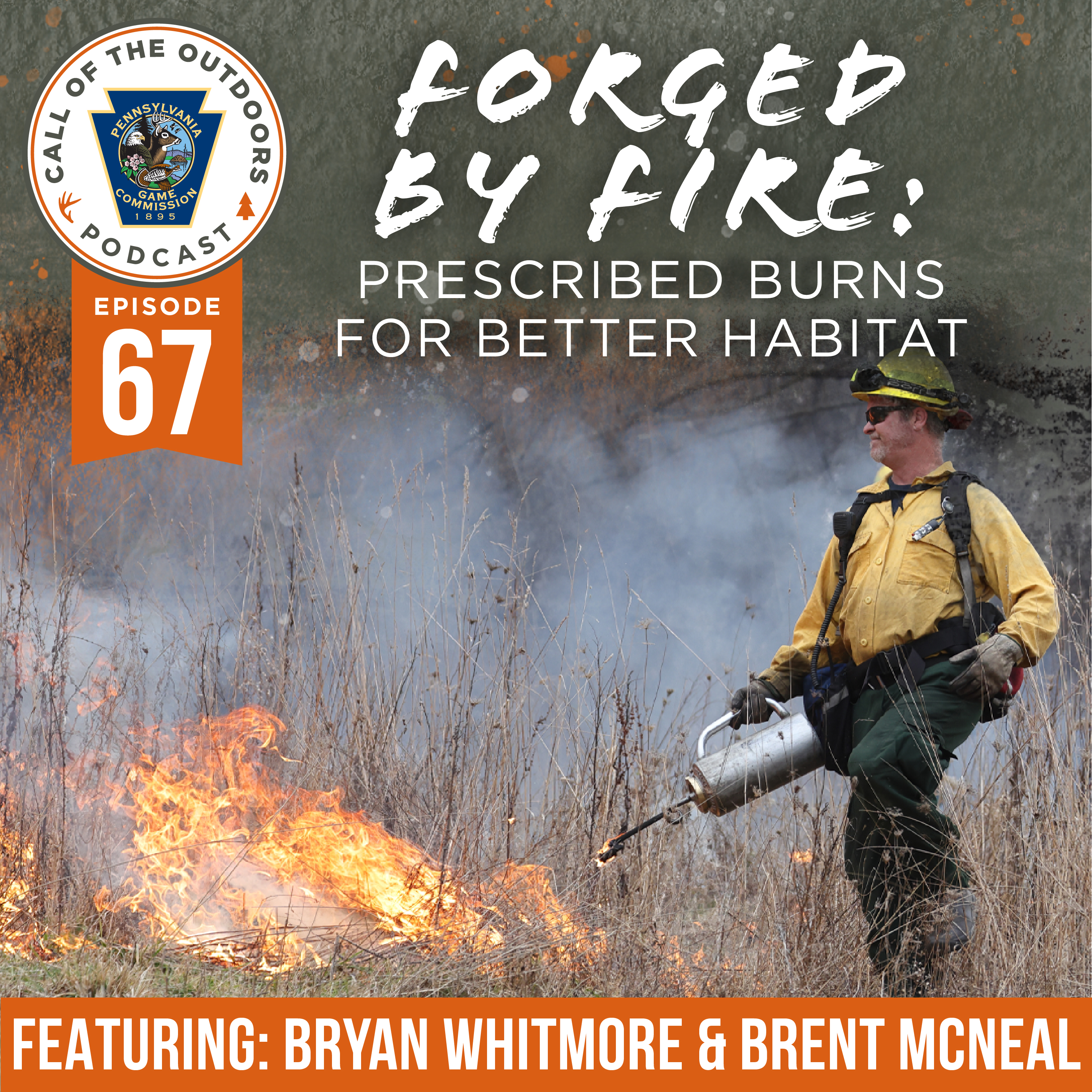
[00:00:31] Speaker B: Hello, and welcome to Call the Outdoors the podcast of the Pennsylvania Game Commission. We're sitting here in the beginning of prescribed fire awareness month. And what better way to celebrate that and kick it off than to talk about what's happening across the state on our game lands. With us today, we have Brent McNeil from the south central region and the manager of the fire program here at the Game Commission, Brian Whitmore. And we want to talk about the whys and hows and what happens here in the prescribed fire program at the Game Commission and talking about habitat and talking about the future and how it lends everything to our mission here at pgc. So we're just going to jump right into it, you know, again, being prescribed fire awareness month and, you know, all the work that we do here at the agency. I have two of the guys here that get the work done on the ground. And I'm just going to turn it right over to you, Brian, if you. If you'd like to introduce yourself and tell us everything about what you do here at the Game Commission.
[00:01:22] Speaker C: Sure.
[00:01:22] Speaker A: Yeah. So my name is Brian Whitmore. I'm the fire program manager here at the Pennsylvania Game Commission. On a daily basis, I help plan all the logistics, operations, everything prescribed fire ren plans, helping guys answer questions in the field, making sure they have everything they need to execute prescribed fire safely and efficiently on the game lands.
[00:01:40] Speaker B: Now, what brought you to pgc? Because you don't have a Pennsylvania accent at all.
[00:01:44] Speaker A: Yeah, I've been traveling around a lot. So.
Born and raised in western Maryland, went to Frostburg State University, studied wildlife and fisheries management, stayed there and got a master's degree in applied ecology and conservation biology.
Then I got really interested in fire and forestry. A lot of that stuff's in the south, so I moved to Tennessee for roughly a year. I was lucky enough to get a job in Georgia for the last five years with the now the Department of War burning for some military projects down there. We were down at Benning, Fort Stewart, just outside Savannah.
[00:02:14] Speaker B: Okay.
[00:02:15] Speaker A: Yep. Just making sure that the. All the ranges and stuff and habitat was in.
Endangered species were getting managed appropriately so they could maintain their training.
Wanted to get closer to home and saw this opportunity come up and was fortunate enough to. Awesome. Get back to Pennsylvania.
[00:02:28] Speaker B: Awesome. Then we have the old timer here. He's been around a long time. How about it, Brent?
[00:02:32] Speaker C: Yeah, I've been around for a little while.
Started here in 2004 as a field forester with the Game Commission out of Huntingdon in the south central region and worked my way up through. And I'm an assistant regional forester now for about 10, 12 years, something like that, I guess. And before that I worked for the U.S. forest Service in Colorado.
I was a firefighter too there. Did a lot of initial attacks and stuff on all kinds of stuff. So when I ended up coming back to Pennsylvania, we really didn't have like true fire crews like we do now. So I just kind of became the like inherited fire expert. They're like, well, you know what you're doing? I'm like, kind of. I guess so, you know, and that. So that's where it all started.
[00:03:17] Speaker B: Awesome.
[00:03:18] Speaker C: Yeah.
[00:03:18] Speaker B: You know, a lot of folks don't realize, you know, a couple things, you know, we have, I don't know how many, you know, 900 employees or whatever it is. And you know, I know both of you guys like to get out there and chase animals to your hunters. And so many times, especially with fire, and it just what goes, it's misunderstood. And that's why we want to talk about today. You know, a lot of things that y' all do on the ground. And when we all look at, you know, our jobs here and our lives and what we're all about, it's leaving it better than we found it. And when you look at prescribed fire, when you can look at it at the long range effects and what happens over the years, I think that's what we want to get through today. But, you know, just, you know, you know, I'll pass it to you. Brian, talk a little bit on both of you about the history of the fire program here at pgc and you know, where it came from. And I know, Brent, you hit on earlier where it didn't really have one when you got here, but we've come a long way in 20 some years.
[00:04:08] Speaker C: Yeah, go ahead. Yeah. So when I started here, we mostly just burned a lot of warm season grass fields and they were small.
Like I remember starting on some burn units at Raystown Lake. And literally we took a five acre field and split it into 10 units.
And that was the level of comfort our crew was good with. And then as time went on and our training got better and our equipment got better, we started being able to all of a sudden burn all five acres of that unit. And then all of a sudden we could take that five acres and combine the five acres beside it and the 10 acres behind that. We could do all 20 acres at one time. So our efficiency picked up quickly.
2000 as the. In the late 2000s, 2009, 2010, our program ramped up more and our training increased and we started having some of our employees, myself being one of them, that started working into more qualified burn boss roles. And we started going into the woods more often, doing a lot more oak silviculture burns, scrub oak pitch, pine barrens burns, and it just kind of blossomed from there.
[00:05:15] Speaker A: Yeah. So to talk about the current status of the prescribed fire program, so what Brent talked about was kind of like the program building phase was mass training efforts, procuring equipment, learning how to do prescribed fire, you know, scaling that up from just a couple acres to, you know, 10, 20, 30 acres. So currently, you know, we're 15ish years into the building of the program, and we've done really well, like getting the trainings. We have dozens of burn bosses now. We have tons of crew, tons of equipment. But I would say now that since I've gotten here, it's been pretty evident to me we need to transition to more of a refinement phase of the program where we're really looking at the objectives, how we're implementing burns, the scale we're implementing burns, how we can move into maybe different seasons other than just the spring, to really, you know, get the objectives or achieve the objectives we want. So maybe more growing season fire.
I think that's pretty important in terms of the future of the program because there's a lot of constraints when you're burning in Pennsylvania. We can get into some of those in a minute. But I would say in general, the program is obviously blossomed the last 15 years, but really we really need to take a, a really good close look at what we're doing, make sure that what we're, when we put fire on the ground, that we're meeting the objectives we want to meet.
[00:06:23] Speaker B: And fire is just a tool in toolbox. You know, that's what a lot of folks, you know, you know, we do timber sales all the time and you know, there's, there's Many tools in that toolbox. And fire is just another one that we use. But a very effective tool.
[00:06:35] Speaker C: Sure.
[00:06:35] Speaker A: Yep.
[00:06:36] Speaker C: I mean, one thing that's interesting, too, is like, you know, there's a lot of research. There's been a lot of research on prescribed fire and a lot. But a lot of the research that's been conducted is like Missouri, the Southern Appalachians, but not a lot in Pennsylvania, essentially, because we've just been burning for 15 years. So, you know, like Brian's saying, you know, we're refining the process. We're finally to a point where we've done enough, where we can start to actually truly refine it. We can look back and see where we're, you know, what's been good, what's been bad, you know, So I think, you know, that's just where we're at now.
[00:07:08] Speaker B: Yeah, you learn by failure sometimes.
[00:07:09] Speaker C: Sure do.
[00:07:09] Speaker B: I mean, that's anything you do, whether you're hunting or throwing a baseball or if you hit a golf ball, I mean, if you're good at it all the time, you wouldn't keep coming back. But that's. I mean, anything. But, you know, so many times let's talk about the time of year, and you said a lot of words in there that folks like, let's just go to this one. Burn boss. What is a burn boss?
[00:07:28] Speaker A: Yeah, so a burn boss is essentially the person that leads the burn.
They're in control of when the match is striked. Essentially, they plan the burn and leading up to the day of the burn, making sure the crew's there, all the prescription checklist is finished. Making sure we're making notifications to the appropriate partners. DCNR, Department of Environmental Protection, local VFDs or Volunteer Fire departments, any other emergency management folks in the counties. There's just inside this prescription, it's a very long checklist that these burn bosses are responsible for. Essentially, the burn plan is a contract between our agency administrator, which is the Bureau of Wildlife Habitat Management director, and the burn boss. So when they go to strike the match, they didn't make sure. Everything in that contract is being followed to a T to make sure that we're within the bounds of the 2009 Prescribed burning practices Act.
[00:08:18] Speaker B: Yeah, and a lot of times y' all go, you have a burn planned. I know. I've seen this happen in my short time here. And like, we're going to go out and videotape it or do something and it gets called off. That's. Oh, because lots of things aren't. Aren't you Know weather or whatever it is, I mean everything has to be perfect.
[00:08:33] Speaker C: Yeah.
[00:08:35] Speaker A: Speaking on timing though, I guess if you look back. So Brent said we're refining, well, we are refining the process now, but leading up to now and still going forward, we have to look back in history and see what actually occurred in the landscape of Pennsylvania. There is a good amount of research through like fire scar studies that show the frequency of fire that as it historically occurred in the landscape. So when we're writing a burn plan and a burn prescription, we're looking at that game land specifically and that area of the state and seeing generally, you know, how long it in between fire return intervals historically occurred. What we want to achieve with this burn in terms of the habitat effects and then what the long term plan of that game lands is through our comprehensive management plans. So a burn boss is kind of like looking at all these things. You know, some other folks help planning in the background but they need to pull all those pieces together on burn day essentially to make sure that we're, we're achieving our objective.
[00:09:25] Speaker B: When you look at that history, how did those fires happen?
[00:09:30] Speaker C: All different ways, lightning strikes, I mean, you know, pre American settlement that was native Americans just lit them to for multitudes of reasons, just to clear some clear land for increased soft mass, blueberries, things like that, for foraging.
[00:09:47] Speaker B: That's crazy.
[00:09:48] Speaker A: Agriculture, land clearing.
[00:09:50] Speaker B: Yeah, they had that fortitude to get that done. I know like when you look in the western part of the country, I mean fire is important and lightning strikes, you know.
[00:09:58] Speaker C: Sure.
[00:09:59] Speaker B: It's amazing to me what fire really does and how it helps wildlife.
[00:10:04] Speaker A: Yeah. Some of those studies show that like, you know, pre settlement of Europeans, like there was a pretty infrequent fire to return, you know, maybe 10 to 20 years lightning strikes mainly that kind of or cultural burning if they wanted to effectuate blueberry response or you know, open up an area for deer hunting or whatever.
But then obviously when settlement came in, we were just land clearing the great cut. And then fires were just rampant across the landscape from like the mid-1800s on. And the fire records show that that's, you know, every six or three to seven years roughly as fires was impacting the landscape which those fires have led to the habitat that we're managing today. So we need to take into account the frequency of those fires because the habitat that's there today and the species rely on a similar frequency to kind of maintain themselves in perpetuity.
[00:10:46] Speaker B: And a lot of people when they, we say habitat, it's a big word that Is used all over in, you know, in wildlife and hunting and whatever. Habitat's a huge word. And you know, our job, you know, your job especially like you're looking at every. The first time I ever went in the woods with a forester here at the game commission, they were down around crawling around the ground. I told this story many times pulling leaves back and seeing stuff that people don't see. And you know, a while ago you talked about fuel. And it's a word that's common in your everyday day to day. But talk about fuel for a second, if you would. So I'm going off script here.
[00:11:19] Speaker A: 100.
[00:11:19] Speaker C: That's fine. So fuel is essentially anything that'll burn.
We talk in fire terms of 1 hour fuels, 10 hour fuels, 100 hour fuels, and thousand hour fuels.
Basically that encompasses everything from a little piece of grass or oak leaf the whole way to a dead snag that's 20 inches in diameter.
So anything that'll burn is considered fuel.
[00:11:44] Speaker B: And that's part of the prescription too, is right. Is the fuel that's in that area. So just let's get away from this for a second and talk about burn day. Like everything that happens on burn day. Like you talked about the prescription. What is a perfect day, time of year? Like if you had all the perfect scenario on burn day, what would it be?
[00:12:02] Speaker C: You mean if I had to pick one?
[00:12:03] Speaker B: Yeah, okay.
[00:12:04] Speaker C: If I had to pick one.
[00:12:05] Speaker B: I just want folks to realize what's going to be.
[00:12:07] Speaker C: To me, a perfect burn day would be a day that's like got some stability in the atmosphere, some stable clouds, real low winds, like 0 to 5 miles an hour, relative humidity 30%, 28% and high temperature of 62. That'd be the perfect burn day.
[00:12:26] Speaker A: Okay.
[00:12:26] Speaker B: That puts a lot into perspective of why we do it that time of year as well, because.
And you talked about the smoke. I mean that's a whole nother thing that folks don't realize that you have to pay attention to and talk about how you plan that.
[00:12:39] Speaker A: Yeah. So maybe to add on to Brent's before we talk about smoke management, like the perfect burn day, a lot of folks think that we're picking these like high wildfire days to be burning. And actually it's the opposite. Like Brent said, we're looking for these shoulder days we call them. Like, obviously there's a red flag warning from the National Weather Service. We don't want to be prescribed burning those days because we're going to consume all the fuel and kind of, you know, degrade the habitat, you could say for short term, depending on the objectives. So we're looking at those shoulder days with higher humidities, maybe some cloud cover, light winds. So we can create that mosaic inside of the burn unit that make the habitat better overall, even short term and long term. In terms of smoke management inside the prescription, as he said, the stability of atmosphere, and we call it the mixing height, which is the lower level of the atmosphere where the clouds are. We really need to pay, we pay attention that very closely, as well as the wind direction and transport winds. So wind direction dictates the way the smoke moves directly from the burn at ground level. As the smoke rises and hits the transport winds, which are, you know, several hundred feet above us, leading up to the mixing height that moves the smoke in a direction. Everywhere in Pennsylvania is pretty densely populated from populated for the most part. Excuse me. So we really pay attention to where that smoke is going to be going when we strike the match. So when we write the prescription, we actually put wind restrictions on some units. Depending on their size, if they're larger units, they're going to produce a lot of smoke. We're making sure we're not smoking in Harrisburg or Pittsburgh or Philadelphia, for example. Airports are a big one. There's a few other sensitive areas. We avoid nursing homes, schools, hospitals, that thing that's all built on the prescription to make sure we're not impacting those with any of the smoke when we strike the match.
[00:14:11] Speaker B: That's what a lot of folks don't realize. You know, we sit here at headquarters and, you know, you'll be burning it at 2:11 back here and you can see the smoke. And I mean, everything in there is, is premeditated and calculated to do it the right way. And you know, obviously everybody is on notice. We try to let folks know that it's going to happen. I mean, you know, through our website and, you know, sometime we can even email a community or whatever it may be. But that's what we're really trying to explain is how important this is as we look at wildlife management and going into the future.
And that tool in the toolbox is, I mean, your window of time of the year right now. Currently, obviously you're looking for some different timeframes to do burns. But right now most of your burning happens springtime of year, right? Am I correct when I say for
[00:14:58] Speaker C: the last few years we've had burn units. We did in the first week of February on top of ridge tops doing scrub oak. I mean, so, you know, of course this year Is a little different.
[00:15:07] Speaker B: We have a little too much white stuff.
[00:15:08] Speaker C: A little too much white stuff, A little too cold, but, you know. Yeah. Typically our fire season starts the first week of February and runs till most of the time. With our PNDI hits, I'd say we get cut off usually sometime in the latter part of middle may, give or take, but, you know, and then picks back up again late summer.
[00:15:28] Speaker B: Pndi. What's that stand for? You have to help us out here.
[00:15:31] Speaker C: Pennsylvania Natural diversity index.
[00:15:33] Speaker A: Okay.
[00:15:33] Speaker B: Explain that just a little bit. I hear that word a whole lot. It's going to help me, too.
[00:15:37] Speaker C: So whoever's writing that burn plan, that's one of the requirements.
[00:15:41] Speaker A: They.
[00:15:41] Speaker C: They run a pndi. So essentially, they create a polygon, a map of the burn unit goes into that program, and then when they submit it, it basically spits out, like, anything that's threatening and endangered from fish and boat, game commission bureau, Forestry and fish and wildlife service.
[00:15:59] Speaker B: Okay.
[00:16:00] Speaker C: So that's essentially what it is. And then we make accommodations based on that.
You know, if there's a plant or, you know, an amphibian, reptile, or a mammal that's affected by that particular burn plan, then we make adjustments to accommodate that.
[00:16:14] Speaker B: How do you make adjustments for something like that?
[00:16:16] Speaker C: Just depends what it is.
[00:16:17] Speaker B: I got you.
[00:16:18] Speaker C: So, like, rattlesnakes. So let's say rattlesnakes, for example. If, you know, we get a rattlesnake hit, it does change our burn window. Shortens it down some. So I think it's April 15th. I believe that's pretty much the standard date that we. Once we get past April 15, we pretty much that that unit is no longer available for that spring because they're
[00:16:35] Speaker B: out of their dens.
[00:16:35] Speaker C: Yes.
[00:16:35] Speaker A: Okay.
[00:16:36] Speaker B: Okay. That makes sense. I. I never. I hear that word all the time. And, you know, folks out there that are listening, you know, that helps us understand that although a lot of people don't like rattlesnakes, but, you know, you know, they're. They're out there, too. Sure.
[00:16:48] Speaker C: You learn to love them.
[00:16:49] Speaker B: Yeah, absolutely. You probably see more than most people ever want to see the time, the year that you're out there.
[00:16:54] Speaker A: So that's just one constraint. Is like the P and D. I. We're looking at the weather, we're looking at the fuels. They got these P and D hits. You got to worry about the crew and logistics of getting everyone there safely. There's just a ton of logistics that kind of maybe this gets into, you know, why we burn so late into May, sometimes during Turkey season.
Sometimes those windows aren't available until, like, that one perfect day comes where everything aligns. Crew weather restrictions from PNDI hits. We can get everyone there, execute that burn to meet our habitat objectives. So it's also important to note, like, we're not purposely trying to burn in May. Most of the time, we want to get that done in February, if we can. But sometimes due to all those restrictions, you know, we don't want to smoke in something. We get pushed back sometimes into turkey nesting season.
[00:17:35] Speaker B: Yeah. And that's a question we get. I get it quite a lot personally about, you know, why y' all burn up turkey nests. And it could happen. I mean, it does happen. We know it does. But when you look at the long range, I mean, talk about what. What. When you put fire on the ground this year, Talk about what happens and why we do that and what we're looking to accomplish when we put that fire on the ground.
[00:17:59] Speaker A: I mean, I would say the objective. The objectives vary unit to unit, from burn plan to burn plan. So in general, unless it's a silvicultural burn, which Brent can maybe touch on, we're not trying to burn every acre scorched black.
[00:18:11] Speaker C: We.
[00:18:12] Speaker A: It's built in. So, for example, maybe I can reference the last year's aerial burn in the southwest region.
The objective there was to create canopy gaps of 50% of the cross entire 2000 plus acre unit. So we picked a moderate weather window day, like one or two days post substantial rain. The fuels were kind of wet. So when we did use the helicopter didn't like to burn. It burned very patchy. It created the pockets or holes in the canopy. Those pockets killed them out in laurel open holes in the canopy, which allowed herbaceous vegetation to regenerate, which kind of kept that because it's really good cover to begin with, but you're missing the food portion most wildlife needed survive. So that berm was really helping regenerate a lot of browse for deer and other species and also created better cover for, you know, small mammals, game birds, and as well as turkeys. So turkeys really love burned edges. So most.
[00:19:00] Speaker B: We're not going to talk about that.
[00:19:03] Speaker A: Giving all my secrets away.
[00:19:04] Speaker B: Yeah.
[00:19:05] Speaker A: So people think, I kind of want to tackle this perception on two is we're burning 2,000 acres scorched black. Really, we're creating a mosaic burn. It's built into the prescription. And so really, if you look at the science, 40 to 60 acres is the. Roughly the. The ideal size checkerboarded for turkey Habitats you have nesting, brooding, foraging, all close proximity. We're doing that at a 2000 acre scale by dictating weather parameters and fuel availability to make sure that burns in that exact mosaic just at a larger scale. So those turkeys have refuge in all that edge burned and you know, unburned areas.
Some burnt, some spots burn hotter, some burn lower intensity and some don't burn at all.
[00:19:40] Speaker B: Right.
[00:19:41] Speaker A: So it just really comes down to the individual objectives written in that prescription. But when we're doing an aerial, you know, like that or even a larger drone or hand handburn unit, we're not trying to do scorched earth black. There's a lot of other objectives we're trying to meet in there.
[00:19:54] Speaker B: Right, right. I know, I know. Like when I go at my house, if I take a rake and lift the leaves, I mean even in hot summer, I mean it's damp down there, it'd be hard to get fire down there. And I'm sure you're that leaf litter as it gets thick, I mean it's tougher and tougher and that's probably where you have to come back annually, I would imagine in some of those places.
[00:20:13] Speaker C: Yeah, I mean like, you know, to touch on some of the silviculture stuff of burning.
So like we're, when we're trying to tackle something and using fire as a tool, as a silviculture with a silvicultural objective.
[00:20:26] Speaker B: Before we talk about silva culture, silviculture
[00:20:28] Speaker C: would be the profess act of forestry. I don't know, something like that.
[00:20:34] Speaker B: Sure.
[00:20:34] Speaker C: But anyways, yeah, silviculture is trees. So you know, we're, so we're working inside of an area here, inside of a, let's say inside of a deer fence and the birch is over topping the oak regeneration.
Of course we're trying to increase wildlife, improve wildlife habitat. So we're trying to grow oak trees, not birch trees. I think most sportsmen can agree that we have oak trees to hunt around than they would birch.
So.
[00:20:57] Speaker B: And that's inside a fence.
[00:20:58] Speaker C: And that's inside a fence.
[00:20:59] Speaker B: Right.
[00:20:59] Speaker C: Where there's no deer, there's no deer. But eventually the fence is going to come down when the oak trees get high enough, hopefully a couple of years post burn. But anyway, so after that, after we run a fire through there and it kills all the small stem stuff and we want it to be uniform across the entire project area.
I would say that the thing I look for like after the burn is that first to like two, three Months post burn at the end of that growing season to really see where we're at. What birch resprouted, how well the oak responded. Typically oaks root colors are a lot better than what than birch and is a lot more fire tolerant. So that good root system puts off a shoot real fast.
Birch, not so much, might sprout up a little bit, nothing crazy. And then we just monitor that and hopefully we don't have to do anything else and we can just allow that to mature, then take the fence down, everything's good. If the birch comes back a little bit, we may have to incorporate a second burn. Usually the second time we go in, it's usually that second entry does take care of the rest of the birch. We'll just have to keep the fence up a little bit longer.
[00:22:03] Speaker B: I know coming away, just talking about fire real quick. And this is. There might. This is just probably redneck hunting science. But I remember when I first started doing food plots long time ago, it was recommended to do to burn them to get rid of any of that seed bank that was keep. You know, and the more you did it, the more you got rid of some of those, those weeds that show up that drive you crazy. And I'm sure it's the same way. What you're saying right there is like when you do it multiple times, some of those unwanted species of trees in there that are, you know, that really don't do any good for wildlife. You can help get rid of them in layman's terms, if you will. I don't know if that's right or not. I'm just trying to weigh in on it a little bit.
[00:22:41] Speaker A: Yeah, for sure. Maybe to get back to you, you said like the, the leaf litter depth, you know, that's a consideration we take into account, especially on first entry. We call it like first time we burn a unit. And really in reality, these units probably haven't been burning 100 plus years. And we talked about historical fire returns. So they're missing several fire disturbances potentially over, over their life cycle or rotation length, whatever you want to talk about.
So when we go in there with fire for the first time, we're battling, you know, jackpots or just severe fuel loading, I guess you'd say. So it's really tough to mitigate almost on the first burn. So that's why we, we really dial it back and make sure that's a cool moisture day, you know, burn and patchiness, make sure we're not just in there scorched earth wildfire, you know, killing the overstory, stuff like that. So the first entry is really crucial that we. We nail which is part of this refinement process. Going back and looking at what we've been doing historically in some of these first entry areas or transitional areas, we want to make a forest into a woodland or savannah, like where we've been successful. Where have you not been successful? And refine our objectives to make sure that, you know, we're successful going forward, making sure we're doing the best we can.
[00:23:45] Speaker B: So just, just for lack of a better thing than to understand, let's say a white oak drop this past October and it starts to sprout how long to that white oak in pretty deep leaf litter till it becomes a tree.
[00:24:00] Speaker C: Till it becomes like a real tree.
[00:24:02] Speaker B: Well, just comes out of the ground,
[00:24:04] Speaker C: you know, if it drops. If it drops this past fall, I would say May, you'll see it coming back up. And that would be considered new oak.
[00:24:12] Speaker B: Okay.
[00:24:13] Speaker C: That's something we do try to avoid burning in, is that when we have new oak, that tree needs longer in the ground to start to build its root system.
So we really don't want to try to bring fire into oak forest with the goal of regenerating it and having that be part of that particular cohort of regeneration to be part of that next stand until the root system is well established.
[00:24:36] Speaker B: Which takes quite a while.
[00:24:37] Speaker C: Doesn't just kind of depends. I mean, a lot of variables error, just the, you know, soil type and quality, growing site quality. But, you know, three or four years that that seedling gets well developed and is at that point, you know, ready to move up.
[00:24:52] Speaker B: I know just walking through the woods with foresters and you'd see where an oak had, you know, many years of development because it was getting eaten. And they're like, that tree's 10 years old. And oh, sure, it's this high because
[00:25:03] Speaker C: I've seen them, they're 25 years old. Look like that.
[00:25:05] Speaker B: That's crazy.
[00:25:06] Speaker C: You dig down in the root collars like, you know, you know, an inch in diameter, that it's just been browsed that many times.
[00:25:12] Speaker B: And it's hard for me as an everyday person to understand that, you know, because you think like a tree grows just like a stalk of corn or whatever, eventually it's 20 years old and giving off, you know, acorns. And it doesn't happen like that. But, you know, and I know we got off topic, that'd be good to
[00:25:28] Speaker A: talk about some constraints of that because that affects, you know, where we can put fire yeah, certain units, sure. Things that keep them from getting to that.
[00:25:35] Speaker C: I mean you know that's, that's the biggest thing is like you know, I was taught a long time ago that regenerating oak forest isn't a, doesn't just, it's not a one time occurrence, like it's a, it's a process.
So we get an acorn crop, we start to establish some oak regeneration. Every regeneration starts to mature a little bit and starts to become go from being a new oak to an established oak to competitive oak and these are forestry terms, but basically from a real skinny little seedling to one that's about three or four feet tall, that's a quarter inch in diameter, I would say would be considered competitive.
You know, we wait till we get some of our oak into that, that, that size class until we really want to start running fire into a stand because it can take that like you could top kill that oak, you know, even if it's four feet tall and it's going to shoot a three foot stock up the next spring, you know, for sure. Like especially when we don't have any deer browsing pressure on them.
[00:26:31] Speaker B: So that's how healthy fire is for sure. I mean you're really increasing the health of the forest when you do this.
[00:26:38] Speaker C: Sure.
[00:26:38] Speaker B: Yeah.
[00:26:38] Speaker A: Okay.
[00:26:39] Speaker C: Yep.
[00:26:40] Speaker A: Do you do any site prep burns like to get oak ready?
[00:26:43] Speaker C: We do some there. Again like a lot of times when you have the heavier leaf litter involved, it is a good way to try to reduce some of that, expose more mineral soil. We get a better herbaceous response sometimes and that just also adds to it as well for wildlife habitat.
[00:27:01] Speaker B: And when we talk about wildlife, you know, so many times we just think about deer, I mean but everything out there benefits from this. I mean from the, from the rodents to the songbirds to you know, our state bird to turkeys to deer, to bear. I mean not every animal that we're and mammal that we're responsible for, 480plus species habitat is different for every one of them. I mean the first trip that I ever made with foresters was on a golden winged warbler project.
And the amount of sign, whether it was deer, turkeys, bear, whatever that were responding to that project because we created this habitat and like you said a mosaic up there on 100, it was crazy. And you know we don't just go out there and cut some trees or light a match like the prescription. There's always an agenda that happens or the comprehend comprehensive management plan. But you know, you know when we look at the Objectives that we're talking about.
And I know it's big term objectives and you know, let's just talk about current year. Like what are we looking at this spring? What are some of the objectives that we're trying to hit this spring?
Providing the snow ever melts, could be a little while.
[00:28:09] Speaker A: Yeah, you go for the South Central, what you're planning meeting.
[00:28:12] Speaker C: We just had a planning meeting. So right now we had about 3,3500 acres, I believe as our priority burn units.
[00:28:22] Speaker B: And that's spread out throughout the region.
[00:28:24] Speaker C: Yeah, that's through our, all our counties. Then that's probably half grass herbaceous units, half forest, give or take. I would think, you know, that. But that's our. That would be if everything's perfect, it works out. And that would be if I was burning today and not sitting here, you know, for us to get there.
So we always plan more than what we can possibly achieve just in the opportunity that we maybe it works out, we do get it all.
You know, honestly, I'd be happy if we could get half of that. And I mean, or two thirds would be great. So.
[00:28:54] Speaker B: Yeah, that's. So, you know, let's just talk about that. Herbaceous units. You know, why. Why would we go and burn grass?
[00:29:02] Speaker A: You want to reduce the thatch, turkey poults, quail poles. Well, that's at Letterkenny, but I'll get ahead of myself here. That's all right.
They need that, you know, space in between the grass bundles to kind of move forage in terms of diversity. That gets rid of the woody encroachment into the units. So burning on like most herbaceous units are less than a three year fire return interval. It's way more cost effective than mowing. Mowing is a part of the treatment process, potentially disking herbicide. All those are kind of wrapped in together on all of our treatments. Fire is just one treatment type, but fire is most cost effective and logistically, you know, efficient, essentially.
[00:29:42] Speaker B: So if I want to get rid of thatch in my yard, I should just torch it.
[00:29:45] Speaker A: You could, yes.
[00:29:45] Speaker C: I've seen it's on you.
[00:29:47] Speaker A: I wouldn't recommend it.
[00:29:48] Speaker B: No, no, no.
[00:29:49] Speaker A: Definitely down here in Harrisburg. No, you could do that.
[00:29:52] Speaker B: I live in Perry county, so I'm good.
[00:29:54] Speaker C: Yeah.
[00:29:56] Speaker A: To get back to Brent. So they're planning 3, 500 acres in the south central region. Priority wise, across the state this spring is roughly 25, 000 acres. It's a similar breakdown in terms of, you know, grass and fields versus woods units. And within those woods Units, you got barrens and woodlands and forests and all these other habitat objectives that the folks in each region are trying to meet, guiding back to their comprehensive management plan.
On average we're burning roughly 11,000 acres. So like Brent said, he'd be happy if we hit half. We're hitting half within that refinement stage we're in now. And going forward we're going to keep looking for ways to improve, you know, our efficiency, you know, how can we do, you know, larger scale, making sure we're getting, you know, we're meeting our habitat objectives in the cmp, so looking for extended burn windows, that type of thing. So it's really so far so good. We're just trudging along looking, waiting for the snow to melt to get.
[00:30:45] Speaker B: After I'm tired of snow shovels, I happen to travel south in this past couple of weeks and it's like when you see 60 degree weather, it's like, oh my gosh, it's coming. And then you wake up and I heard red wing blackbirds and it's just like spring is just a whole new life is happening and that, you know, let's talk about you run a fire through, let's say woodlands for instance and you.
I'm talking like you guys sound like you run a fire through.
Yeah, I know, you know, when you look at short term objectives and then let's look at long term objectives, just, you know, so many people don't understand the reason and I know we kind of hit some of that. Let's talk about it again, like right away. What do you expect to see from that? Like when you're coming back and you monitor it and then you know, what, what are your long, what are the long term benefits of prescribed fire? And that's a big word. I know, let's just, you know, try to condense that as much as possible.
[00:31:39] Speaker C: I mean, I know one of the first things when I walk back into a place right after it's burned, like I said, I right after it's burned on to me it's like the end of that first growing season. What's it look like? And a lot of times like in the woodland setting, if we're getting what I would like to think we're we're going in the right path. We're seeing a lot of native grasses like Indian grass, little bluestem, definitely some of the rubus and some starting to show show up in there. We were getting, you'll see some response hopefully from some of the oak species. But there's A big herbaceous component to that woodland.
So sparse overstory with herbaceous component in the understory.
[00:32:20] Speaker B: Erubus is like raspberries, blackberries.
[00:32:22] Speaker C: Yeah, yeah, yeah, I got it.
[00:32:24] Speaker B: Yeah, I'm getting on.
And all of that is the component. Now let's talk about long term. Let's talk about three years from that burn.
What would you expect?
[00:32:34] Speaker C: Burn it again.
[00:32:35] Speaker B: Really?
[00:32:35] Speaker C: Yeah.
[00:32:35] Speaker B: Okay.
[00:32:36] Speaker C: Yeah. I mean, if woodland management's our goal right there, I'd say in three years we'd be doing it again.
[00:32:39] Speaker B: Okay, and what would that reason be?
[00:32:43] Speaker C: Basically at that point, we're trying to keep that herbaceous component in there. If we just take fire out of it and this was primarily forest when we started or just a regular forested stand, it's going to revert back into forest again. It wants to be woods. So, you know, that's why we're using fire as a tool here. We're reintroducing that and on a return interval to create, to create and maintain that woodland community.
[00:33:06] Speaker A: I got you.
[00:33:07] Speaker B: I got you.
[00:33:08] Speaker A: Yeah. I think the herbaceous component is the biggest part. I mean, most of the closed canopy forestry in Pennsylvania, you can see 2, 300 yards through when you create. You know, take that to a woodland with all that herbaceous component. You can have woody stems kind of popping up, oak seedlings and stuff like that scrub oak, mountain laurel patches. But when you have that herbaceous component on the forest floor and that light is getting through the canopy and helping that stuff regenerate, way more food per acre than you wouldn't have a closed canopy setting with just o acorns falling.
[00:33:35] Speaker B: If they ate leaves, it'd be okay. That's all we can find.
[00:33:37] Speaker A: Yeah, they dead leaves that we'd be in good shape.
Yeah. So per acre browse and forage is way higher.
The COVID is better.
Sometimes you can walk for me to you before deer jumps up out of a three foot tall grass versus you're in an open oak stand. They can see 300 yards away coming.
[00:33:53] Speaker B: So from a hunter. I want to see that.
[00:33:55] Speaker C: Sure.
[00:33:55] Speaker B: I want to see like that. Where it's thicker or.
[00:33:59] Speaker A: Yeah.
[00:33:59] Speaker B: You know, secrets away now. Well, not all thickets are created equally. I mean that's, that's, that's the big thing. And what, what fire is doing is bringing that natural stuff back up to the, to above our heads.
[00:34:09] Speaker C: I mean it's some of the best deer habitat we have on game lands is some of these, these burned, these regularly burned units we have.
[00:34:16] Speaker B: And I can tell you from a turkey hunter's perspective, especially in the southern part of the country. You know, if, if. And they're burning, they can burn with one person down there a lot of times. And you know, a lot of those, especially people I've hunted, you know, in the quail areas in north Florida and that smoke still rolling in the sky and the turkeys are in it. I don't know if they're getting burn up bugs or what they're doing, but they, for some reason it draws turkeys when you, when There's a fire.
[00:34:43] Speaker C: 100%.
One of the guys I used to work with here, I remember when he was doing some of his grad work, I believe, if I remember the story correctly, he told me that a lot of the folks down south, like their camouflage was literally like black because they would just slide right into a patch of burnt woods. And they don't make too much for a pair of dark coveralls.
[00:35:05] Speaker B: Right. Well, it's pretty cool, I thought. Yeah. The problem is they can see you better when all the stuff's going. They sure can see a long ways, but they spend a lot of time out there for sure. I guess it creates food immediately for them.
[00:35:18] Speaker A: Let me interject there.
[00:35:18] Speaker B: Yeah.
[00:35:19] Speaker A: So we were just. Game commission helped DCNR with the Michaux wildfire this past spring. We had, you know, tons of people there, lots of equipment, but on the first day we got our butts whooped, you know, trying to fight this thing. But 16 hour day and we're driving out, you know, it's sunset and the turkeys are just running back into this where this wildfire just rolled through the trees are still smoking and stuff. Like, if this isn't a textbook example, turkeys love fire.
It just hit me then that, well,
[00:35:42] Speaker B: and that brings up a great point. Let's, let's just hit on the difference between a wildfire and a prescribed fire. You know, some people see it the same thing and it really isn't. I mean, you were talking about scorched and scorched earth. You know, if we could just touch on the difference of, you know, the, the complete difference. And obviously sometimes our fires probably get too hot. I mean, it can happen. And let's, let's hit on that if we could.
[00:36:03] Speaker C: Yeah. So, you know, a wildfire starts from a single point, typically, and spreads from there.
There's no prescription. It just burns where it wants to. It burns where the wind blows it. So fire intensity is not controlled.
You know, not saying that all wildfires are, you know, a detriment to all habitat. Conditions, but there's no control to it.
[00:36:27] Speaker B: It's burning stuff up.
[00:36:28] Speaker C: It's burning wherever it wants to go until we put it out or, you know, until firefighters put it out.
Of course, prescribed fire is completely different. Instead of, you know, that wildfire, we're trying to put a box around it. We already have a box, so we're just working it inside that box. That's the biggest. That's the biggest difference as far as, you know, how they burn and how they respond, as far as fire intensities, things like that.
[00:36:54] Speaker A: Yeah. So if you look like on the news, if you see a wildfire, typically California or, you know, Australia or somewhere where it's just like we call a. A crown fire. It's running through the canopies of trees never. And, you know, PGC is not going to have anything close to that. Our typically, our fire flame lengths are less than 4ft, and that includes all the habitat types we're trying to manage. Once you get over four feet, which we may do occasionally if we have a specific habitat objective. But for 99% of the time, our flame lengths are less than 4ft, most of the time less than 2ft. And it's backing, creeping around. It's not running with the wind uncontrolled, where we're able to control it and meet our habitat objectives. It's also.
Brent got me thinking. So when I first moved to Pennsylvania, you got to get up to speed on the history of fire in Pennsylvania. We managed in the fire program for the Game Commission. So I started doing some research, and it's pretty astonishing when you look back in the history, how many acres actually burned in Pennsylvania post European settlement, you know, with their land clearing and kind of develop the habitats we have today. So roughly 3 to 400,000 acres on average back in the 1800s, early 1900s, before we really cracked down and started suppressing fires. So it's a pretty eye opening to think like that's. If you think about that today, just 300,000 acres of wildfire moving across the landscape of Pennsylvania. It's hard to imagine right now for context, we're less than 5,000 acres.
[00:38:09] Speaker B: It'd be pretty awesome if you could close your eyes and go back to that time and see what Pennsylvania looked like back there. And I know, you know, I remember first trips again with, with Dave Gustafson, and we were looking at timber sales and fire. He was showing me all kinds of different tools in that toolbox. And he goes, basically we're trying to create natural.
That's what we're trying to man made create when we go in there and do this because that's what creates new timber. Like you look at a beautiful hardwood ridge, it's nothing but oak trees. You know, eventually you need to do something if you want to manage that for wildlife. Because I mean like you said, when you can see 500 yards, that's not, that's not the greatest habitat out there. I'm sure it's creating some food, but there's no cover and there's lots of, you know, the browse issue for whitetails. I mean a deer needs five pounds a day to make it, especially this winter. I mean they were hungry this winter for sure. And you know, when you're doing these, when you're doing prescribed fire, you're creating that. I mean, obviously. And you know our hats are off to you because I know it's, it's a science. Let's talk about again about burn day. Like how many guys are on one of our.
I mean, I know it varies, but it varies.
[00:39:13] Speaker C: Like I would say for a forest unit and girls.
[00:39:16] Speaker B: I'm sorry, we have girls on our crew.
[00:39:18] Speaker C: Absolutely.
I would say an average crew for a woods burn is probably around 18 or 20. I would say most of the operations I've done, I mean I've had more, I've had a lot less. But 18 to 20 grass, anywhere from 6 to 10, 6 to 12, just depends.
[00:39:37] Speaker B: And I got to watch one a couple years ago in the north central region and it was pretty amazing. Like you know, all the pre meetings and the post meetings and like, and continuing watching for hot spots that get outside. And I mean it's a pretty neat thing to see happen. And you guys have it dialed up for sure.
[00:39:54] Speaker C: Yeah. And I mean we've also used technology in our, for our advantage at this point. Like most of the regions I believe now have a drone.
[00:40:01] Speaker A: Yes.
[00:40:02] Speaker C: So a lot of our ignition is done with drone. Well, that used to be done with five guys dragging a drip torch through the brush.
So, you know, that's five people first off, we don't have to put inside a burn unit from a safety standpoint. And that's also five guys that we can utilize somewhere else. Whether it's for holding resources or possibly on another burn somewhere.
[00:40:21] Speaker B: So because that window again is short.
[00:40:23] Speaker C: Short.
[00:40:25] Speaker B: You know, there's. We get a question too a lot about like burn ban days. And you know, we'll see there's a burn ban across the state and we can burn. I mean we do prescribe burn. Let's talk about how we can do that and why we do it.
[00:40:38] Speaker A: Sure. So maybe I'll kind of give the context. So I believe it's under the Forest Fire Protection act, counties can implement burn bans. So what how that process works is 50% or greater of the fire chiefs in that county can recommend a burn band for whatever reason. You know, they're responding to dozens of wildfires or brush fires. They make that recommendation to the DCR district forester. DC and our district forester takes that recommendation to the county commissioners. County commissioners vote to enact a burn ban.
Most the time this process is reactive versus proactive. So the fire volunteer fire departments have been responding to numerous fires that are taxed, tired, you know, depleted of resources. So then that's when they push the request forward.
What happens for us though a lot is and burn ban gets enacted for 30 days. It can be enacted again extended for an additional 30 days.
So within that 30 day window, conditions change drastically. Even in a couple days.
For example, snow can melt in the next two days and sun comes out and we could potentially be burning. If the burn ban was enacted for the next 30 days and we get this shift in weather or fuels where we can be burning, then that's where the conflict arises that we have to work through trying to meet our habitat objectives with those narrow prescription windows that were in prescription. But there's a county burn ban. So maybe I'll let Brent kind of talk through how he, he works through that.
[00:41:51] Speaker C: Yeah.
So it seems to me like a lot of the times when there's a burn ban acted like it is almost like always rains like the next day and it's 30 days.
[00:42:02] Speaker B: So that's how we know there's a higher power.
[00:42:04] Speaker A: Yeah.
[00:42:05] Speaker B: When you really think about.
[00:42:06] Speaker C: Yeah. So the biggest thing is communication with, you know, with dcnr, the local fire departments.
Luckily, I guess from being here forever, the old guy like you said at the beginning, I have pretty good communications with the fire chiefs across south central Pennsylvania and talk to them, talk to the county commissioners. So it's up front. This is what we're doing. This is why we're doing it. And this is the type of a unit we're working in high fire when they're chasing wildfires all over the place and it's really that dry. We're not burning.
That's something to be important to note that like we're not working inside of a burn ban when it truly is high fire danger.
[00:42:47] Speaker B: That's when you see the smokey the bear sign with it all the way.
[00:42:50] Speaker C: Yeah. When it's on the red. Yeah. When it's on. Yeah. When the arrows on the red, no go. Yeah. So anyways, you know, that's important to make sure that people know that, you know, we're burning on when conditions moderate and we're in good communication with the public or with the agencies and the jurisdictions.
[00:43:06] Speaker B: Yeah, we get a lot of calls to dispatches, you know, when there is a burn ban out there, and I'm sure you all know it and hear it, but I mean, there's nothing reckless that we're doing out there for sure.
[00:43:15] Speaker A: No. When Brent starts making his planning calls in the region during a burn ban, he also notifies me and then he also conducts an extra risk analysis, you know, making sure that all those extra boxes are checked. He's talking to the right people. We've kind of double checked that the prescription, you can still meet objectives. Even though, you know, they're saying that we're in a burn ban, obviously we don't want to do anything that escapes our prescribed fire unit and causes issues for, you know, local communities or the public. So there's just extra steps we also have internally when we're in a burn ban to make sure that when we step outside of that, we obviously, I talk to our partners at dcnr, let them know that, hey, we're going to move forward with a prescribed fire on game lands. You know, 48 or whatever the game lands is. It's currently in a burn ban, but here's why, with that checklist that we're going to proceed just helps with our partnership. And then obviously Brent's checklist make sure that all his ducks in a row when he strikes a match.
[00:44:01] Speaker B: You know, we talked about a lot of the things, the whys and the wears and let's, let's look at it from the hunter's perspective, Brent, if you will. And how. Why is. Why is our prescribed fire program so important to hunting?
[00:44:14] Speaker C: So I guess I'll try to get a little more specific. Like, let's talk about a hunting species that a lot of guys hunt. Guys and girls. White tailed deer.
[00:44:23] Speaker B: It's a keystone species. Yes, it is.
[00:44:25] Speaker C: And honestly, like, one of the main reasons why I wanted to come work for the Pennsylvania Game Commission is because I love to hunt whitetail deer and I want to be part of this.
[00:44:32] Speaker A: So.
[00:44:32] Speaker C: And making habitat better. And the thing that I really like about our, the results I've seen with our fire program. And we'll go into some of the woodland management and the scrub Oak pitch, Pine Barrens management. Like when I think of that, when the COVID we're being able to manipulate here to create that environment, it's the same exact cover like types that I look for. Like when I go to Illinois or Ohio, you know that, that grass mixed with regenerating oak and you know, it's just that thick, thick stuff, but yet with some, some openings in it and things like that. Like I.
What we're doing out there is definitely creating better deer habitat for sure.
[00:45:15] Speaker B: And when you see that the first time, first time you went to the Midwest and you saw that, your eyes,
[00:45:20] Speaker C: like, I sure mean, honestly, to me it kind of looks like a lot of what I see in the understory in our woodlands is real similar to what they call set aside fields out in the Midwest, crepe fields, like where it's like saplings and grasses and things. It looks a lot alike. And so from a habitat standpoint, it's like the carrying capacity increases, the food capacity increases. Some of the biggest bucks I see on state game lands come from those areas.
[00:45:45] Speaker B: So when you, I mean you kind of have an inside. I mean it's your job. It's fringe benefits of having a job. So like you go back there and look at like when you do these projects, you go back and check it out. I'm sure, I mean, sure. And the information that's out there today in mainstream media and you know, I was riding with a guy a couple weeks ago, well, months ago, that worked for DCNR in a state forest. He's a forester there. And Chase's big bucks. Corey Galvis.
[00:46:15] Speaker C: I don't know. I know Corey.
[00:46:16] Speaker B: Yeah.
[00:46:16] Speaker C: School together.
[00:46:17] Speaker B: Oh, okay.
[00:46:17] Speaker C: Yeah.
[00:46:18] Speaker B: So he was, he was showing me all the cuts of, you know, his. And he's like. He said there is a trail camera on every timber sale that I've had in the last. Because people know, I mean, they know where the deer at right now. And it's. And it's important. Like we get so many comments. There's no deer left.
Everything changes out there.
[00:46:35] Speaker C: Sure.
[00:46:35] Speaker B: Tremendously. And we got to stay on top of that. And you know, we can talk about all that stuff, but you know, pay attention. If you're hunting game lands, look at the places where I mean these things are happening.
[00:46:45] Speaker C: And the thing is now with the technology, like Onx shows you like where it is, you know, it is like anybody, Everybody that, that HUDs, at least guys I hunt with, everyone has that. So they just turn it on. They just turn on the treatments and on State, four state game lands. And it shows all the timber sales. I think a burn units are on there, if I remember correctly.
[00:47:06] Speaker A: I'm not sure about that.
[00:47:06] Speaker C: I know this. I know the timber sales are for sure.
You know, so like you said, the habitat, the treatments are right there at your fingertips.
[00:47:14] Speaker B: I mean, that's, you know, when we look at our partners dcnr, I don't know what their objective is with fire or anything like that, but ours are directly related to habit or to wildlife and habitats. That's our mission. And, you know, when you look at prescribed fire, again, it's that tool in the toolbox.
[00:47:28] Speaker A: Absolutely.
[00:47:30] Speaker B: I know, I know you wanted to hit on some things before we get out of here.
[00:47:32] Speaker A: Can I just echo what Brent said? So I just came. You spent five years in Georgia. It's pine savannah, so open canopy pines with, like, shrubby, grassy understory. And like, if you went to a pine plantation, you know, closed canopy, nothing onto the understory. I definitely wasn't hunting there. But when I first moved to Georgia, coming from the mid, you know, mid Atlantic, I didn't really know what to be looking for in terms of habitat, where to find the deer. After the first year or two, kind of had a mentor show me around. I was consistently killing nice bucks out of a pine savannah where all this thick, you know, habitat was due to, like, repeated prescribed fire. So the principles are the same when. Even when you move back here, like, the thicker the habitat, the better the.
[00:48:10] Speaker B: Is pine straw, like, as a fuel, is it a little bit different than leaves?
[00:48:15] Speaker A: Yes, it's. It's more. More flammable and becomes available much quicker.
That's why in the south, every day is a good burn day, because you can burn at 80% humidity.
One, you know, six hours after rain. I've actually burned units. It was raining.
[00:48:29] Speaker B: Wow.
[00:48:29] Speaker A: As we were, you know, igniting the unit, you get back into Pennsylvania, the oak leaf litter, or when you get into some of the mesophytic species like red maple or birch, it's, you know, it's gotta be much drier for those leaf litter to burn. Converses, pine straw.
[00:48:42] Speaker B: And does. Does fire mitigate? I'm going down this.
[00:48:45] Speaker A: Go ahead, Keep going.
[00:48:46] Speaker B: Does fire mitigate when you get to that damp leaf litter at the bottom? Does fire help mitigate that. That dampness that's in there, the soils at all?
[00:48:53] Speaker A: Or I think repeated prescribed burning can change soil composition. Maybe burn the duff, we call it. So 100 years of decomposing leaf litter creates, like a duff layer, like thick Wet, you know, it's great. It's becoming soil essentially when it gets dry enough that duff can burn.
And so yes, over repeated, you know, once you get the leaf litter gone from a first burn or two, if you start picking hot dry conditions in the prescription to burn, you can actually start consuming some of that duff.
[00:49:19] Speaker B: Does that change ph or anything in
[00:49:20] Speaker A: the soil, all that stuff? Yeah, it makes nutrient cycling, the phosphorus. Yeah, it gets. We don't want to go down those wormholes, but it's there and improves the nutrient cycling, releases all that, you know, pent up, you know, carbon and all that stuff kind of gets released again, becomes available. For those herbaceous plants, here's the time that they suck up and.
[00:49:37] Speaker B: Sure.
[00:49:37] Speaker A: I mean, that's used to grow.
[00:49:38] Speaker B: To me as a, as a hunter looking at a burn, the coolest thing is when everything goes from charred to green like that, you know, and just first rain. Yeah. And the bugs and everything that just, it just all starts to happen. It's kind of like spring, all this snow melts and all of a sudden daylight hours are getting longer and like life just happens again. That's what I look at a burn unit as.
And then to see the long term effects like you were talking about, where we're, whether we're growing oak habit, oak forests or fields and grasses. And forbs. That's a term that took me a long time to realize that forb is a fancy word for flowers, but deer love them. I mean, that's awesome. I know there's some other things you want to talk about, more like on the private side of things and you know, like a lot of questions we get from private landowners.
[00:50:27] Speaker A: Yeah. So I do a bunch of outreach events across the state. As I'm traveling around the Game Commission truck gets stopped by people and they always ask, can you burn my land for me?
We cannot burn your land for you. But I'm glad you're asking because in the last two years, the Pennsylvania Prescribed Fire Council, because of the Prescribed Fire or Prescribed Burning Practices act, have created this program called the Certified Prescribed Burn Manager Program.
It's a part. Well, in the Prescribed Fire Council, there's all these different agencies, dcnr, pgc, tnc, other partners. But this Certified Prescribed Burn Manager program is a certification process for private landowners, consultants, et cetera, where they can become certified. And once they are certified, they get liability protections from the state to implement prescribed fires safely.
So part of that training is it's 40 hours of online firefighter type 2 training which all of the Game Commission Fire crew has and then it's a three day or 24 hour class with several instructors. We kind of get into the burn plan writing, what to put in your prescription, how to write objectives, we go look at burn units and kind of talk through some things, how to put in fire lines, what type of equipment you need, all that stuff. So when they graduate that class, they can go write a burn plan and do some checkoff burns we call them with certified mentors, I think it's two or three burns. And once they do their check off burns, write a burn plan and have that check make sure all their safety's in line, they can essentially submit all their stuff as a package and become certified. Once they're certified, they're certified to burn and implement prescribed fires at low complexity. Currently the council is going to be working on how to get folks to moderate complexity. So I don't want to dive down this wormhole, but right now we're kind of as you, the scale changes as the fuels change. You start burning in a, in a woodland with all these different variations and structure between forest floor, mid story and overstory. We don't want crown fires, we don't want, you know, flames moving up into the canopies, which could happen if you pick the wrong day on, you know, to strike the match. So once you're a certified prescribed burn manager, you can start implementing low complexity burns, mainly in grass.
But there's gonna be a process eventually where they can start implementing moderate or wooded, wooded burns, which is going to open up prescribed fire in the private sector in Pennsylvania, you know, wide open. Sure. Because there's a ton of acres out there that folks want treated. So you're going to be consultants and private landowners, farmers, hunt clubs, they can get certified and then they can start implementing this habitat management on their land.
[00:52:50] Speaker B: When you look at our state and how much of it is forested across the state and I mean we can only work on 1.5 plus million acres. And we're doing the best we can on that, on that land. And we're. When you talked about, you know, talk about some of the certifications that our folks that put these on the ground, what certificate? You know, we're not just putting somebody in a fire suit and putting them out there in the woods. I mean there's some rigid training that happens for the folks that are putting fire on the ground.
[00:53:16] Speaker C: Yeah, I mean I would say basically from a like Brian said, like a firefighter type two to being like an RXB2, a burn boss like us, you're looking at 10 years.
I'd say when it's all said and done from start to finish, you know, that's. I would say that's pretty.
[00:53:33] Speaker A: Yeah. So a burn boss, it takes hundreds of hours of classroom training and then I would say thousands of hours of experience, documented experience through taskbook completion, which is like a checklist of what you have to do to lead a burn and lead people and make sure you're picking the right day. So, like. Like Brent said, it's. It's not like I'm going to join the Pennsylvania Game Commission, be a burn boss next year. It's a dedicated group of folks that have passion, that want to aspire to that, and the program wouldn't be successful without burn bosses or fire leadership in general that even get to those intermediate stages of leadership to execute these burns.
[00:54:06] Speaker B: That's awesome. And hats off to all the employees that are out there that just want to leave it better than we found it for sure.
[00:54:12] Speaker A: Yes.
Maybe one other thing I'll add.
[00:54:15] Speaker B: Absolutely.
[00:54:15] Speaker A: We have.
The first ever prescribed fire festival is going to take place April 18th at the Middle Creek Wildlife management area. The rain date for that's going to be April 25th. So these CPMs that are already certified, I believe there's eight or nine of them across the state. We've had two classes already.
Some of those are going to. Some of those folks are going to be there. So if the public wants to come out and get in contact with some consultants as maybe start burning, meeting some of their objectives, whatever they may be. We're also going to do a live burn demo for the public to show them, you know, from test fire, which is the. When we strike the match to how we move crews, how we ignite, why we're doing that. There's gonna be some guided tours, food trucks, you know, vendors. It's gonna be a whole big old fire party.
[00:54:55] Speaker C: Yeah.
[00:54:55] Speaker A: Big old fire.
[00:54:56] Speaker B: There you go.
[00:54:56] Speaker A: Exactly. You may even get a bonfire going at the end of the day.
[00:54:59] Speaker B: Hit the dates on that again.
[00:55:00] Speaker A: April 18, Middle Creek Wildlife Management Area. Okay. The rain date, if you know it rains, you can't do the fire Demo. Will be April 25th.
[00:55:06] Speaker B: Okay. And. And they can. You can check out our website, too. We'll have that information on our website.
[00:55:10] Speaker A: There's.
[00:55:11] Speaker B: That's pretty incredible. We'll have to get the guys down there with some cameras and get some pictures as well.
[00:55:15] Speaker A: That'd be good.
[00:55:15] Speaker B: Yeah.
[00:55:16] Speaker A: And then maybe my final. Final closing would be like, thank you to the Pennsylvania or the prescribed fire leadership like Brent and the other guys, the burn bosses, and then the entire crews. Without the crews, we wouldn't be successful or be able to implement all these habitat treatments with fire game lands.
[00:55:30] Speaker B: Right. Well, thank you. Thank you, gentlemen, for coming and joining us and enlightening us on everything that happens. Sometimes, you know, when everybody's doing it for reward, somehow most of it's for ourselves to leave it better than we found it. But, you know, I encourage folks that if you run into somebody out there that in one of the yellow suits that. That you see on game lands or whatever, thank them for working hard to make it better out there for. For all Pennsylvanians and for all wildlife. But thank you all for your dedication to the Game Commission into the future of wildlife and hunting and trapping.
[00:55:58] Speaker A: Thank you.
[00:55:59] Speaker C: Thank you.
[00:56:00] Speaker B: Y.