Episode Transcript
[00:00:00] Speaker A: Hunting is the way that we manage game animals. And you know, that's why the seasons and bags are set that way.
So, you know, we want deer around and turkeys around and bear around for the next generation as well.
[00:00:12] Speaker B: And whenever I shot a deer for a couple decades, actually my tradition was I'd sit next to the deer and eat that candy bar. And that was my celebratory cigar at the time.
[00:00:22] Speaker A: We're in the middle of firearms deer season. We got the holidays right around the corner. It's just a great time of year to be a Pennsylvania Hun.
Well, thanks again everybody for joining in for another episode of Call the Outdoors. And this one's kind of special. I mean, number one, we're in the first week of deer season, firearms deer season, and you know, fall's been a little crazy. I know we have our special guest, our executive director, Mr. Steve Smith. And you know, you've had a tough hunting season this year. You've kind of been on the sidelines.
[00:00:54] Speaker B: A little bit, almost a non existent one.
[00:00:56] Speaker A: You know, he had, you know, knee replacement and they tried to give you a little overhaul and you got a little bit of a flat tire.
[00:01:03] Speaker B: A little bit. A little bit, yeah.
[00:01:04] Speaker A: But you're gonna come back after that?
[00:01:06] Speaker B: Absolutely. The good thing is it's a long season this year.
[00:01:08] Speaker A: That's right.
[00:01:08] Speaker B: There's still time.
[00:01:09] Speaker A: And that's the cool thing about seasons and opportunities. You know, so many times we, you know, think about things. We have some incredible opportunities in this state. And you know, with what we did, you know, the holidays are coming, we wanted to make a special episode and we went out and asked questions to our audience on Instagram and we have a lot of great questions. And you know, we've selected some questions that we're going to answer here on the podcast. And for any of you that submitted questions, we're going to get back to you with a DM here in the next few weeks to answer the questions that you've had. And you know, one thing I want to make light of, we see this a lot on social, social media channels where somebody has a question out there on a group somewhere and they get 14 different answers. You know, especially when it comes to the laws, you know, we have, our resources are deep here at the agency. If you have a question for us, you can send us a GM comment, you can look at our website, you can go to our Digest, or you can call our dispatch at 8:33 PGC HUNT and get those questions answered. Because even in today's World where you Google it, you know, AI is pulling information from everywhere, you might not get the right information.
[00:02:12] Speaker B: It's a great point. And as you know, I've been fortunate to do a lot of, we'll call them town halls across the state. And to your original point, I think it's safe to say our hunters have a lot of questions. Always it's the Q and A part of those events that keep me there the longest. And it can usually just keep going well into the night. So looking forward to doing this. But I think your point is also well taken that at the end of the day it's the experts at our website, at our Digest, that's the informations you want to go on. Not kind of heard it from somebody down the road who said this. So to the extent that again, you can find that answer on our website, calling our dispatch, looking into the Digest, that's your preferred way, right?
[00:02:51] Speaker A: And you know, this year obviously we've had some changes with Sunday hunting that happened after the digest happened, you know, was printed. And you know that that can occur. And to that point, before we jump in here, let's talk about the process, how things happen, because we talk about this a lot. But I think it's important for the folks out there that are tuning in our constituents and the residents of Pennsylvania to understand how the Game Commission works with our board. And if you will, Steve, you articulate it. So awesome.
[00:03:16] Speaker B: Sure. We are set up, of course, by statute. There's a game of wildlife code that controls everything that we do at the Game Commission. And that law creates nine members of a Board of Commissioners. Those Board of Commissioners have the final say in what our seasons look like, what the bag limits are for those seasons, the time that they occur, all of that. Our staff provides recommendations and our staff reviews the data that we have, be it biological data, be it from surveys on hunters, on their viewpoints, and then they give that to our board of commissioners. And our board makes the best decision that they can in light of the data that's provided to them by staff. So it's a two step process. It begins here in a couple of weeks in January every year. The January board meeting is when that process begins and our board comes in. Here's preliminary recommendations from staff. Review some of the data that's available and begin setting the seasons and the bag limits for that fall for that license year. They come back in April and finalize those proposals, make them final, and that goes into our digest. So it's a very compressed time period from January To April, and then mid to late April is when that digest goes to the printer. But that sets the parameters that our hunters have to go by for that upcoming hunting seasons.
[00:04:35] Speaker A: Absolutely. And you know, when you look at hunting as a whole, I mean, we see a lot of things out there. We've got some questions. You know, hunting is the way that we manage game animals and, you know, that's why the seasons and bags are set that way.
So, you know, we want deer around for turkeys around and bear around for the next generation as well. And we have to look at that. It's not always to the convenience.
I mean, even you and I, sometimes we feel like maybe that decision, but that's our personal opinions. When the data tells us to do something, that's what we have to follow as an agency.
[00:05:07] Speaker B: And we're fortunate to have a board that has really embraced that, that philosophy of making the best decisions based on the data that's presented to them. With the goal of how can we maintain sustainable wildlife populations for generations to come.
[00:05:20] Speaker A: Absolutely. Yeah. I want, you know, someday we're both going to have grandkids, hopefully, and we're. We want to make sure they can go out there and hear a turkey gobble or see a whitetail or a big. Whatever it is. Exactly. I mean, it's so important. And when you look across the country, hunters are the first line of conservation.
And we respect and appreciate and take everybody's comments, questions to heart. I mean, we do every day. I mean, it's something that happens here at the agency. But we're going to jump right into the questions.
[00:05:46] Speaker B: All right, let's do it.
[00:05:48] Speaker A: One of the first questions we got, and I hear this a lot, what are some of the. What are the roadkill regulations? When you see a deer that's smashed aside the road, which happens.
We're fortunate to live in a state that has a lot of deer. I mean, we see it all the time.
[00:06:04] Speaker B: It's true, we do. In fact, Matt, you and I talk about it. We get the same trip into work every morning.
And this time of year, you know that road that you're going to see roadkill deer on it.
So what our regulations allow is that if an individual sees a deer that is killed, and that's an important distinction, I'll come back to that. But if an individual sees a deer side of the road hit by a car is killed, they can call into dispatch, our dispatch center and request a permit to consume that deer to be used for, to process for venison, for meals, et Cetera, So they absolutely can reach out and request what's called a consumption permit.
Getting back to that distinction I made, though, about that the deer is killed, individuals cannot in Pennsylvania see a deer injured on the side of the road and try to dispatch. Dispatch that animal. And I understand as hunters, that's certainly our first instinct. Right. Nobody wants to see an animal suffering. But if you think about the safety risk, if just any member of the public were to try to put a deer down or bear down or whatever it is on the side of the road, you can see the concerns. And that's why the law is written the way it is, that only a game Commission officer, who sometimes will defer to that local law enforcement officer if they're the first ones there on the scene, but only the law enforcement has the ability to put a deer down. So I just wanted to make that point, since we're on that topic. But nonetheless, to your original question, there are. There is a process, there is a way where an individual who sees a roadkilled deer can get that meat for consumption.
[00:07:35] Speaker A: And, you know, if it is a buck and you want to inquire about the antlers, there's a charge. But you can get a permit for that.
[00:07:43] Speaker B: That's right. There is also a permit that. For that. It's a separate permit. There's a charge that goes by how many points the buck is. But that is also a possibility as well.
[00:07:52] Speaker A: Yeah. The one we're looking at is only 20 bucks because it's Spike. Bug. Spike.
[00:07:55] Speaker B: Yep.
[00:07:57] Speaker A: And the other side of the thing, when you. When talking about dispatching, it's, It's. It's the liability part, too. We're trying to protect the folks out there because, you know, the safety risk is a major concern when you do that. So again, our number at dispatch is 8, 3, 3, PGC Hunt and 24. 7. And they're going to take your call and get someone out there.
[00:08:15] Speaker B: And again, can certainly empathize with those. First, that first reaction of you'd hate to see an animal suffer.
[00:08:20] Speaker A: Right.
[00:08:20] Speaker B: I think we all feel that way.
[00:08:21] Speaker A: Absolutely.
[00:08:22] Speaker B: But it is, like you said, the safety concerns. That's why the law is written the way it is. And last point I'll make on this is I just recently spent the day a couple Sundays ago with a warden, and he got a call that a deer had been hit by a car was laying on the side of the road. And we drove there, he was able to put that deer down. And then he had a list of families in his district who had said, when that situation comes up, I would love to have that meet. So he made a few calls, and we were able to get that to somebody who needed that meat. So it's great in situations like that where that deer doesn't go to waste.
[00:08:53] Speaker A: Sure, absolutely. That's awesome.
That's what it's all about, for sure.
So next question is relating to Sundays, which obviously this year with, you know, full court press and that it happened. And it's. It's crazy that all of a sudden we can hunt on Sundays now in Pennsylvania. You know, we both have probably acquaintances and friends that are out of state that I've gotten made fun of my whole life about that. But here we are. We're here.
[00:09:19] Speaker B: It happened.
[00:09:20] Speaker A: So, you know, the question is about after Christmas this year. And obviously the board made some decisions earlier in the year, being that it just passed right before hunting season for the most part. But let's talk about this year and what's available current year after Christmas, and maybe look into the future a little bit.
[00:09:37] Speaker B: Sure. And you're right, you know, Sunday hunting happened so quickly this year. We didn't have time to get it into the digest, didn't have time to do a full analysis of what it could look like. The emphasis for this year was just getting it in place for those fall hunting seasons. And we were fortunate enough to do that for 13 Sundays this year. Coming up to the very end of that, I believe it's Sunday. December 7th is going to be the last Sunday this year in which there will be hunting on Sundays.
[00:10:02] Speaker A: That's this weekend.
[00:10:03] Speaker B: It is, believe it or not. It came quick, didn't it? So moving forward, for this license year, which ends in July, for this license year, there is no more additional Sunday hunting other than what was already provided in the law, which is for foxes, coyotes, and crows. Those are the only species that can be hunted. Moving forward, however, as I talked about earlier, you know, the board starts that process again every year of looking at what seasons, what those dates should be. So I think as we get into January timeframe, start having our board meetings, one of the things that we're gonna be looking at is whether or not we can expand those Sunday hunting dates. I think doing it this way is the right way. Let us incrementally phase it in. Let's see what kind of impact it's having. Let's see what kind of participation we're getting from our hunters, and every year analyze whether or not we can add onto those list of Sundays. But for this year, for this calendar year, for this license year, there's no more Sundays after December and rifle deer season.
[00:10:55] Speaker A: And that's an important thing to remember. And, you know, we talk about this a lot. You know, we're number two in the country with licensed hunters. There's a lot that goes on. And, you know, being turkey hunters, you know, I see a lot of turkey hunters asking, you know, why it didn't happen. But, you know, when you throw an additional five or six Sundays into our turkey season, we gotta make sure that the resource can handle that. And it's really important to think about it in that light more than just another opportunity. And that's one thing we're doing for sure.
[00:11:23] Speaker B: Yeah, definitely. And that's a great point, I think, for all species, but, you know, in particular turkeys, given how sensitive that species can be, we wanted to err on the side of caution. We wanted to slowly, incrementally make the decisions about where Sunday hunting can be implemented. And there just wasn't that comfort level yet for this year that we could, for this upcoming spring in 26, that we could include a full slate of Sundays.
However, we're going to analyze it. We're going to see if there's some adjustments that can be made. I would recommend our hunters stay tuned as the board goes through that process, because we're going to ask for input from our hunters on what they would like to see and look to see if there's a way, a path forward where we can responsibly implement Sunday hunting even into spring gobbler season.
[00:12:04] Speaker A: Right. And if you're, you know, if you're interested in tuning in, this stuff's all going to come to light, going to happen here in January at our next board of commission meeting. And it is live streamed on our YouTube channel. And, you know, we encourage you to tune in and follow along and see how this process works. And it's pretty interesting when you do get involved in that. And I encourage all sportsmen or all folks that are interested to tune in.
[00:12:27] Speaker B: Absolutely. And for turkey, like we've been talking about, another one is waterfowl. We're going to be, again, very interested in what kind of input we get from our hunters. Those are two species that.
Two groups of species that we didn't make any changes for Sunday hunting for this year.
However, Sunday hunting is now an option. It's now on the table. It's something that can be considered moving forward. So our board, our staff is going to be looking for input from hunters on where they would like to See those seasons.
[00:12:52] Speaker A: Awesome.
[00:12:53] Speaker B: Pretty exciting.
[00:12:54] Speaker A: Next question. We're flipping over to more of a law enforcement question. And the question is, have you seen the number of game offenses or violations increase or decrease over the years?
[00:13:03] Speaker B: Yeah, that's a great question, and I certainly appreciate the interest in it.
Unfortunately, it's a difficult one to answer specifically because the number fluctuates so much based on how many officers we have out in the field.
And when that number of officers is high, we see that the number of violations and prosecutions goes up. When it's low, the number goes down. And during those down periods, I don't think it's a result of violations not taking place. I think it's just not having the personnel where we need to be to detect those violations.
So it makes it difficult to say specifically, again, whether or not they're increasing or decreasing. But what I think it does make clear is the need for us to have that robust law enforcement force, our game wardens out in the field, and in many instances, relying on tips that they're getting from members of the public who are interested in wanting to know what's happening with Pennsylvania's wildlife.
So I can't stress that point enough. If you're an individual, if you're a hunter, member of the public who sees something taking place that you know to be against the law, you know, reach out to the Game Commission so that our officers can look into it.
[00:14:12] Speaker A: They can even reach out to our OGT hotline, which can be anonymous. And, you know, the OGT saying is poachers or thieves. They're stealing from everybody.
[00:14:19] Speaker B: They are indeed.
[00:14:20] Speaker A: If you see something, say something for sure.
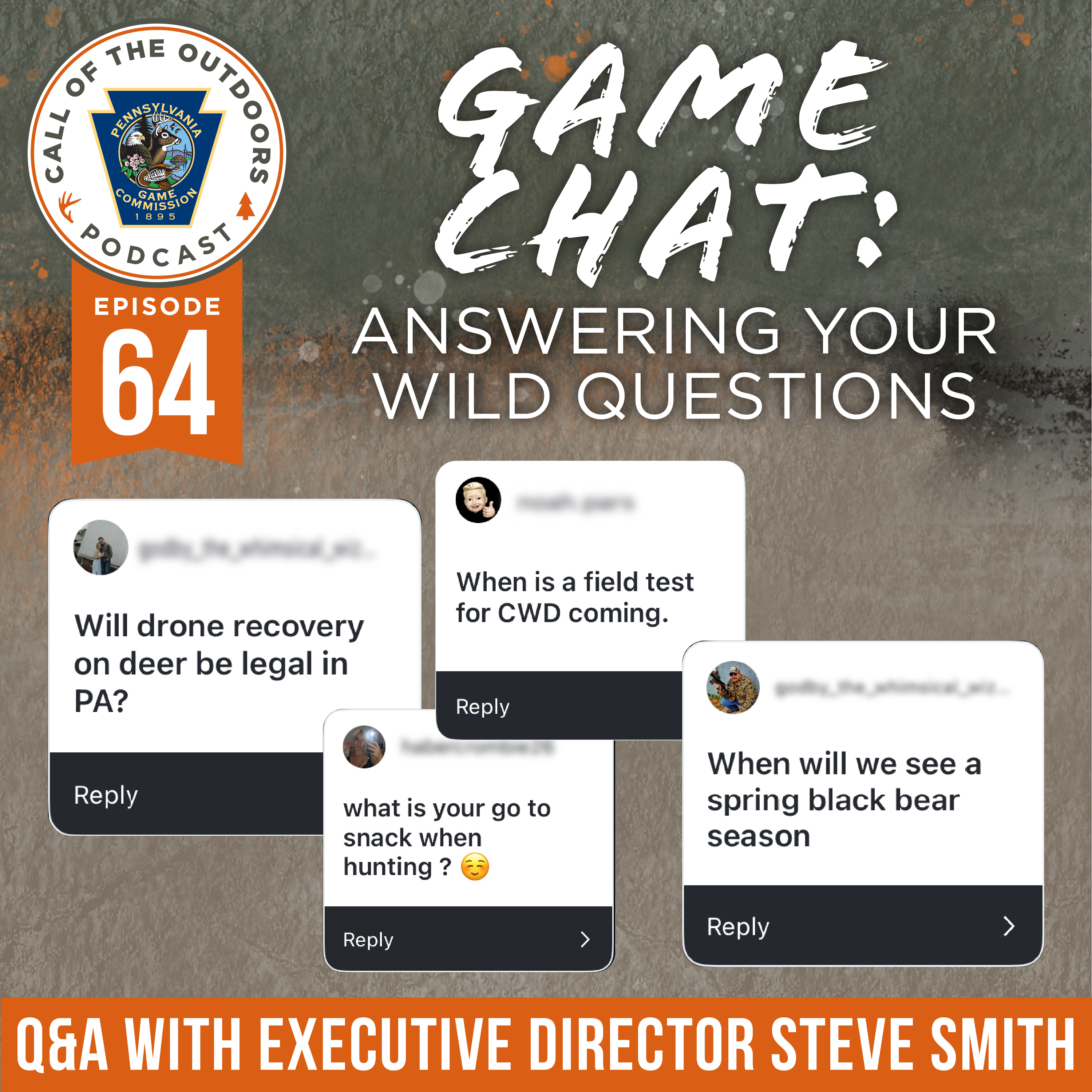
So the next one, it was kind of interesting when I read this, but, you know, I've heard talk about this throughout my life, but it says, will we ever see a spring black bear season?
[00:14:34] Speaker B: A spring black bear season? I. I'm hesitant to say never, but I would say I don't anticipate we'll see one anytime soon. I think if you look at our bear harvest and population numbers, one thing we've seen over the years consistently is that we can manage that population through our fall hunting seasons. And anybody who hunts bears knows those seasons have changed in the past couple of years. They expanded.
Now they're decreasing as far as that October timeframe.
But those seasons seem very sufficient at managing the population numbers. And as long as that is the case, I don't anticipate that we'll see a spring black bear season.
[00:15:14] Speaker A: And, you know, we get a lot of comparisons. Sometimes to other states.
We hear that a lot. We have to realize we have a couple hundred thousand bear hunters in this state. And you know, that's, that's a big play in when we think about these things.
[00:15:29] Speaker B: Absolutely. It's, it's hard to do a straight apples to apples comparison between Pennsylvania and other states, particularly other states out west where there are spring black bear seasons in place. They just simply don't have the population of hunters that we do. And with that population means not as many opportunities as some states might have. Because it's all about, as we talked about earlier, managing that population at a sustainable level for generations to come.
[00:15:53] Speaker A: When you look at some other states, and I know I'm going off base here, but we have more hunters, licensed hunters, than a lot of states have in population. You know, when you put that into perspective, that's how these decisions are made.
[00:16:03] Speaker B: I talked to one individual recently who said we have almost twice as many hunters as they do general members of the public in their state. So that limits, again, some of the things that we can do because of that. But what a, what a great situation we are in to have a number of hunters that we do.
[00:16:17] Speaker A: I'm proud of that. I mean, for sure.
So here's one. And you know, this just goes to show, like the reason that we're doing this is total transparency. You know, obviously this issue's come up in the last couple years. You're seeing it a lot all over the place. But will drone recovery for deer ever be legal in Pennsylvania?
[00:16:37] Speaker B: Some things would have to happen first before it could be.
In particular, there would need to be segments of the law, sections of the law changed that would authorize the use of drones. Drones are an electronic device. Currently, the law prohibits the use of electronic device except with certain exceptions. So that would need to be expanded. Those exceptions would need to be expanded to allow the use of drones. One thing we would also want at the same time is the ability to regulate their use. So they would have to be permissible under Title 34 under the law. And then there would need to be a section for the Game Commission to regulate their use. That's typically, if you look at methods for hunting, that's the way it takes place. They're legalized under the law, and then our board establishes regulations. So that kind of two step process would need to take place here in Pennsylvania before we could talk about what legalizing drone use for recovery would look like.
[00:17:29] Speaker A: Okay, okay. And you know, when we look at that in technology, there's a lot of things that technology is moving so fast today in lots of different aspects and just want the folks out there to rest assured that we're looking at every measure on a daily basis as things change. I mean, we're on social media right now as a state agency and so many folks get their information from social media, but who knows where the next outlet's gonna be? And we all know it's coming, so we're trying to stay ahead of those processes.
[00:17:59] Speaker B: Absolutely. And that's a great point. And that is why we would still want, as the agency, the ability to regulate you use of drones, so that we could make changes theoretically to that regulation that keep pace with the changes that are happening on a technological standpoint. So that's why, again, it's a two step process, typically where the law will create a new exception to allow a type of use and then the Game Commission comes in and regulates it. So currently, though, neither of those steps have taken place. That would have to be what happens before we could talk about drone usage.
[00:18:28] Speaker A: Awesome.
Next one.
How old must you be to start pheasant hunting? And you know, obviously there's a lot of different things out there. There probably is some confusion. So we're just gonna set the record straight.
[00:18:40] Speaker B: Sure. Pheasants can be hunted under a mentored youth permit. So an individual, and there currently is no age limit on when an individual can purchase a permit. We leave it up to the adult in that child's life to determine whether or not they are responsible enough to start hunting to get that permit.
But an individual who buys that permit, say 8, 9, 10 years old, can go out, and at that point, obviously they haven't bought a hunting license yet. But if they have that mentored permit as well as a pheasant permit, which is free, they can go out and start pheasant hunting.
[00:19:12] Speaker A: Right. And you said something that's really important and through personal experience, I'm sure you had the same experience.
Not every child's ready at the same age. We have to take it upon ourselves as parents or mentors to know when that right age is. Just because someone's 8 doesn't necessarily mean they're ready to do it.
[00:19:29] Speaker B: Some kids might be, some kids might be. Absolutely. It's so specific to that individual, to that kid, and who knows better than the adult that's in their life to determine when they're ready for that or not. I've had two kids and they varied greatly on when they were ready.
Certainly my oldest was plenty ready by the time he was 8 or 9. My youngest, he needed a few more years, and we started him out with squirrels, and we stayed there for a while until he was ready. And I think the way our regulations are set up is we let the adults make those decisions, handle each kid on a case by case basis, and, you know, graduate them into the hunting process incrementally, step at a time. Right.
[00:20:05] Speaker A: Don't force them. And that's our job as parents or mentors, to know the right time. So, next question. And it's kind of going to revert back to some things we talked about, Steve, but are we going to be allowed to turkey hunt on Sundays in the store spring?
[00:20:19] Speaker B: The only thing I can say with absolute certainty is not in 2026, unfortunately. And I know that's something we'd probably all like to see, all turkey hunters, but not for 2026, which isn't to mean that it won't be in place for 27 or 28 or moving forward. But for this year, for this license year, which includes the spring of 26, there will not be turkey hunting on the spring. In the spring, we want to look at some options. We want to get a better handle on the data. We want to talk to hunters, get what their input might be.
You know, there's been a lot of changes to turkey hunting in the past couple of years. We've allowed a second tag for spring gobbler. We've also expanded the seasons to include full days for part of the season. We want to look at all those options, make some decisions as to what the best plan is moving forward. And I think you'll see our board begin to have that discussion in January, in a few weeks, when they look at what the seasons for spring gobbler should be in 2027. But for 2026, there is no spring gobbler hunting on Sundays. Yeah.
[00:21:18] Speaker A: And again, we're going back to what we talked about. We got to make the best decisions for the resource. And as much as we'd all like more opportunities, we got to make sure that it's the right thing. And turkeys have been kind of scrutinized across the country in the last few years.
Lots of states, they're looking at that turkey program, and it's our job to do that in the upcoming year.
[00:21:39] Speaker B: I think it's well said. And I mean, let's face it, it would have been easy to say, sure, Sundays are now included in spring gobbler season. You get, you know, four or five Sundays. Here you go. But what if we had made that change and Then it had a significant impact on that population. You know, what if it disrupted that breeding cycle at the wrong time, hens weren't able to nest appropriate. You know, all those things that could have happened, we would have then started to peel it back, restrict the season, you know, shorten it. We didn't want to make that change mistake. We didn't want to go too far too fast. So we didn't make any changes for 26. Now again, everything's going to be on the table moving forward when we look at 27. And I look forward to having those discussions. But I appreciate our hunters, you know, being patient and letting us do the right thing because I think we all want to make sure that population continues to stay at a huntable level and sustainable moving forward.
[00:22:26] Speaker A: Absolutely.
Next one is, this is a good one too. I mean, we've had some great questions. And thank you, those out there that sent in questions because, you know, like, we want, we want this, this engagement because this one's a good one. And I have this question myself.
What are the rules for packing a deer out of the woods? Like if you're way back in and you're quartering it up or whatever and you know what kind of proof of sex requirements are there?
[00:22:51] Speaker B: Sure.
So we know that when you harvest a deer, that tag's got to go in the ear. Right. That's the current regulation. All our hunters know that tag's got to go in the ear.
Then it gets complicated. I'll say when you start cutting that deer up. Right. When you got it in various parts.
So the requirement is if, let's say, you shoot an antlerless deer, put that tag in the ear, quarter it out, you're putting the quarters in your backpack, that head has to come out with that meat with the tag still in the earth.
And I think for this rule, for all of our rules, they're in place for a reason. Right. So put yourself in the shoes of a warden. If that wasn't in place. If you could just come out of the woods with a bunch of meat with no tag, no head, he wouldn't know, she wouldn't know whether or not that was, let's say it was a four point and you're an adult who could not lawfully shoot a four point, he or she would have no way of knowing that.
So given that, that requirement that the head with the tag deer stay with that deer even as it's coming out of the woods in various parts, that regulation still is in effect at all times until such time as the de, as the deer is dropped off for processing, you know, from there on, certainly the butcher separates the head from the rest of the body. But until then, when bringing it out of the woods or when traveling to your residence, that ear still must be, that tag still must be in the ear and that head must be, have to meet perfect.
[00:24:21] Speaker A: And that, I mean, that answers it all. And you know, when you're way back up in some of the places that you hunt, that's how you have to get a deer out of the woods.
[00:24:27] Speaker B: Or used to hunt until I hurt my leg.
[00:24:29] Speaker A: But you're coming back.
[00:24:30] Speaker B: Yeah.
[00:24:31] Speaker A: Next question that came to us is, is going back to the two bears. And it's so why is bear season not open for the entire archery season or shortened? And on the same token, why did we shorten the bear muzzleloader season?
[00:24:43] Speaker B: Yeah, it's, it's great question. And it's, it kind of goes back to something that has been a theme for us here today, which is our hunting seasons are designed to help us manage wildlife today and for generations to come. And we understand as hunters there's certainly a recreational component to that. Right. Like we enjoy our hunting seasons, we like those longer hunting seasons. But that balance is that those seasons have to be set at a level that allows us to responsibly manage wildlife. So how this applies to bear in the past couple years is we saw that population increasing.
So as that population increased, we expanded the number of seasons that were available. We included up until recently it was a three week archery season, a full week of muzzleloader season in that October timeframe that had never been there 10 years ago. That was unheard of. But we did wasn't just the recreational component. It was a management decision in response to that growing population.
Now, and certainly the harvest data isn't complete for this year, but as we start to see indications that that population isn't growing or wasn't at the level it was a couple years ago, we're certainly not getting the bear complaints that we were at that time, particularly from farmers, because a bear can be devastating to a cornfield. We know that now. We're taking a look at it and seeing whether we should be shortening those seasons in response to a decrease in complaints in the population. Population not at the level that it was.
So there's certainly a science behind it. I think there's a biological science, a social science, and it changes year to year with the population. So again, as that population increases, the seasons increase. When the population comes back down the seasons come back down.
So we'll again go back to it. We'll give our board data in January and then again in April, let them make decisions based on that data and determine where that right balance can be.
[00:26:31] Speaker A: And that that's perfect. And you know, again, I'm going back to the. You got to remember for the person answering asking this question or people that have that question, you're one of a couple hundred thousand people that enjoy going bear hunting. And you have to remember those numbers are strong out there. And they are, you know, that see those seasons did exactly what we had to get done. And that proves that we, you know, we're doing the right thing and moving in the right directions.
The next question, a pretty simple one. Can you hunt bear with a bow during bear season?
And I think they mean during firearm season.
[00:27:05] Speaker B: Right. The general rule, and it certainly applies for bear as well, is that whenever there's a firearm season in place, you can always use what I'll call the lesser implement. So if it's a firearm season, you can absolutely use a muzzleloader, flintlock, an archery, archery tackle, whatever the case may be. And that's a great rule to have in place because for bear, for firearms deer season, it allows archery hunters, particularly if you're in a neighborhood where you don't have that 150 yard safety zone that you need for a firearm, but you can responsibly hunt in closer distances. You know, maybe it's 100 yards, 75 yards, if you're using archery tackle, it's that decreases all the way to 50 yards.
So given that for those in, again, in those populated areas who want to use a bow during firearms deer season, bear season, whatever the case may be, case may be they have that opportunity.
[00:28:00] Speaker A: And just to caveat on that, if you're going to use, and this is where some people get confused, including myself, but if you're going to go in firearms deer season with a bow, you do not need an archery license.
[00:28:12] Speaker B: Correct.
[00:28:12] Speaker A: But you know you need the archery license for archery season.
[00:28:15] Speaker B: Right.
[00:28:15] Speaker A: And you know, the same with bear. If you want to use archery tackle, you have to have a bear, a bear license, but you don't need an archery license.
[00:28:23] Speaker B: That's correct. You do though need the fluorescent arms requirements that you would use as if you are firearms hunting. So some complexities built into our seasons, no questions about that. Which is again wide, check the digest, call dispatch and we'll get you the answers you need. Right.
[00:28:37] Speaker A: So here's one that should be pretty quick, but this One I thought was a really good one. What is your personal favorite snack when you're out there in hunting season?
This one could get good.
[00:28:49] Speaker B: I know it's almost sacrilegious to say this, but I don't know that I have one currently.
And I say that again, understanding how important the connection is to snacks and hunting, particularly as a parent.
It's amazing how you can't step a foot into the woods when you have kids and they want their snacks.
Incredible how that works.
But I will say, going back, and this goes way back, but I can remember as a kid reading a game news magazine and an individual talked about how he packed a cigar with him and whenever he shot a deer, part of his ritual, you know, fill out that tag, sit down next to the deer, and have a few puffs on the cigar. I was like, let's say 13 when I read that article. I wasn't packing cigars with me, but I made it. My kind of tradition is I would go to the general store near where we hunted deer. I'll give a shout out to Kenny's country store in Cross Fork, Pennsylvania. And I would buy a candy bar. And I bought a Baby Ruth candy bar every year on the night before deer season. And I put that in the bottom of my backpack. And whenever I shot a deer for a couple decades, actually, my tradition was I'd sit next to the deer and eat that candy bar. And that was my celebratory cigar at the time.
And that meal with a candy bar, a cold candy bar sitting next to a deer was by far my favorite meal of the year.
[00:30:10] Speaker A: Probably broke some teeth off.
[00:30:12] Speaker B: Probably.
[00:30:13] Speaker A: That's awesome.
I'm gonna go with this one because this is kind of. I go way back with this one, too. Since I can remember, it was a Lebanon bologna sandwich that my dad would pack. And I still try to carry that traditional. And I don't. I mean, I probably eat bologna sandwiches. I only during deer season, but it's one of those things. And you know, when you see social media today, like cupcakes and their Christmas tree cupcake. But to caveat even our answers, the social team this week is going to ask the folks that tune in here and the folks that tune into us on Facebook and Instagram, they're going to ask the same question. So I'm excited to see what those answers are going to come back with.
[00:30:49] Speaker B: Yeah, I think they probably run the gauntlet and are all over the place and there's some superstitions and traditions and built into all that stuff.
[00:30:57] Speaker A: Absolutely. Thank you for that question. But one thing that we get this a lot, too. And this question came multiple times when you look at our agency. What is the best way to get involved with the Pennsylvania Game Commission as far as careers go? There's so many things that happen here at the agency, and if we can just elaborate a little bit.
[00:31:18] Speaker B: Yeah, no, that's a great question.
There's room for so many different career choices within the Game Commission. I think it would shock people.
Certainly the law enforcement side, that's probably for most people, hunters, that's the first thing they think of on the Game Commission, which is great. The reason for that our wardens are most visible aspect of our agency. So certainly the law enforcement side. But then, of course, there's the biologist.
We have gamelands maintenance crews. We have foresters out on the ground every day.
We have people like in your division, communication staff.
So there's a whole spectrum of career choices that one can go. Who has an interest in working for the Game Commission. I'd recommend. Follow us on places like LinkedIn, Facebook, check our website.
One thing I'll also offer is reach out to the Game Commission employees in your area, be it at the regional level.
For me, when I wanted realize that I needed to work for the Game Commission, I reached out to somebody in headquarters who I just saw had left a job that I was very interested in, so I knew I could find him. I knew we had some similar connections, so I literally tracked them down and said, how can I work for the Game Commission?
I think we encourage that. We want to hear from people who have an interest, and we know certainly a lot of our hunters do, and we welcome those who have that background to join our workforce.
[00:32:41] Speaker A: Yeah, myself, you know, in the hunting industry for as long as I was in it, and I, at the time was reading Twitter and saw a job posting. I'm like. And. And I'm like, this is cool. And, you know, obviously you interviewed me and from a tree stand in the middle of Oklahoma, and here I am. But. But there is lots of opportunities out there. And to be quite honest with you, in the six years I've been here, I've watched a lot of turnover. I mean, people retiring and things changing and some additions and, you know, if you have interest in wildlife and our mission to hunters and outdoorsmen and wildlife, for sure, check us out. There's always opportunities out there. And there's, you know, whether it's our website or LinkedIn or wherever, you know, there's. That information is all out there.
[00:33:27] Speaker B: It Is, and I would certainly never say that you need to be a hunter or trapper to work at the Game Commission. I can think of dozens of great examples where employees have that background, just have an interest in wildlife and conservation. And there's no question. That being said though, if you do have that background, it certainly doesn't hurt when you can come in and already have that kind of background knowledge of how we operate and what our mission is. So would encourage anybody to take a look again at, follow us on social media and look at LinkedIn in particular.
[00:33:54] Speaker A: Yeah, the passion inside the walls at headquarters and throughout the regions for the mission of the agency is pretty incredible.
[00:34:00] Speaker B: It is. That's a great way to put it.
[00:34:02] Speaker A: Here's one we hear quite a bit. And I'm old enough to remember this.
Why not go back to a three day doe rifle season?
[00:34:11] Speaker B: Yeah, certainly heard this one dozens and dozens of times.
I think the short answer is a three day antlerless deer season just doesn't give us enough time to get that harvest that we need to manage that population.
There's too much at risk in a three day season.
You think about what could happen from the weather standpoint, it could be too hot, it could be too cold, there could be snow, sleet, rain, whatever. It may be that if the agency put all its eggs in one basket, so to speak, from a deer management standpoint on that three day season, it would be opening itself up to just potential to not get the harvest that you need. And if we don't get the deer harvest that we need year in and year out, we know how quickly that population can increase and the kind of damage that they can do to our forests or agricultural communities, to motorists on the roadways like we talked about. So it is so critical that we keep that deer population where it needs to be. And we just can't do that responsibly on a three day firearms deer season.
[00:35:10] Speaker A: Yeah, I mean, times change. I mean they really do. And you know, we're in a different day and age. And when you, when you look at it, I remember those days and there's no way we could do that today, like 100%.
So the next one obviously was somebody that was tuning in that was a little bit younger. It says, are you still a junior hunter at 16?
[00:35:31] Speaker B: You are. And in fact, you can even be a Junior Hunter at 17. Believe it or not. It really depends. And what it all comes down to is your age at the time that you buy that junior hunter license.
If you buy it and are 15 and turn 16, still perfectly legal. If you buy that junior hunter license and you are 16 at the time that you buy that license, and then you turn 17 during that hunting season, you are still considered a junior hunter for purposes of our special seasons. And we have them for pheasant, we have them for spring gobbler, we have a deer firearm season. So it all depends on your age at the time you bought that license. So again, as long as you were under 17 when you bought that license, you're still considered a junior hunter in 16.
[00:36:17] Speaker A: If I remember correctly, and remember this from person at 16, you can hunt on your own. Yes, you can.
You don't need to be accompanied by an adult like you are up till you're 15. So 16 is when they set you free, when you get scared of the dark and you try to get all over all those fears.
[00:36:33] Speaker B: Absolutely.
[00:36:33] Speaker A: The next one is obviously something that is talked about a lot. We hear this word every day and try to be on top of everything we can. But when is a field test for CWD coming?
[00:36:46] Speaker B: Yeah, that's a, that's a great question. As somebody who hunts in a DMA, two DMAs would certainly love to have a field test with me at all times. The short answer is we don't know it's in development. We're working towards it. I, I don't think I could be responsible to give a specific timeline and say this is when it'll be, other than to say it's a priority for us. We would absolutely love one. Again, as hunters from the agency standpoint. But what I can say is we've made it a priority also to have those head collection bins out there. So if you're hunting in a dma, can't encourage it enough, drop that head into that bin so that we can test that sample. And the wait time has gotten significantly better. I can remember when it was measured in weeks, when it was two weeks or so until we could get those results back. You know, that left everybody in limbo while you were waiting. Now it's been shortened down to a couple days. And we've heard. I got a response just the other day from a hunter, was so pleased that he got his, his test results back in four days. That's much more, you know, manageable than a couple weeks. So we've made great strides on that front. We'll continue to do so and really recommend our hunters use those head collection bins.
[00:37:50] Speaker A: Right when you look at the test. So that's everybody in the country is looking at that too, not just Pennsylvania. So, I mean, you can rest assured that that is front and center on a lot of folks radar.
[00:38:01] Speaker B: Yeah.
[00:38:02] Speaker A: You know, something that all of us in Pennsylvania are proud of is our game land system. And the next question was, do we plan on purchasing any land in Delaware county, which I think is the only county we don't have game lands, right?
[00:38:14] Speaker B: That's correct. It's the outlier. So just from that standpoint alone, I think we would love to have a parcel of game lands in Delaware County. We were even fortunate enough a few years ago to get one in Philadelphia County.
And it's my understanding that is heavily used by the hunters who go through that process, get the permits to go on there and hunt. So would certainly love to have one in Delaware County.
Without knowing any specifics as to whether or not there's any parcels on the market currently or not, I could just say that if that opportunity were to arise and if there was a parcel that made sense from our standpoint that we could manage for wildlife, we could get our hunters on there. There's good access points to it.
If that opportunity were to arise, I think it's safe to say that we would certainly explore that opportunity. You know, we've been very fortunate over the past couple of years to have our revenues that be at such a healthy standpoint. And what we've done with that windfall essentially is we've reinvested it back into hunting, and a lot of that means by acquiring more game lands. If you look across the state, we've made some incredible acquisitions, including two that are just minutes away from downtown Pittsburgh and from downtown Harrisburg. So we are always looking to expand our game lands where it makes sense and where the opportunity arises. So it's a case by case basis, as you would expect anytime you're talking about a land transaction. But if the opportunity were to arise and if it made sense for us to do so, we would absolutely look at buying land in Delaware county, too.
[00:39:43] Speaker A: It's one of those, like the old times saying all the stars have to line.
[00:39:45] Speaker B: They do, they do. Certainly in a real estate transaction.
[00:39:49] Speaker A: The next question, I saw this one earlier, is kind of makes me chuckle a little bit, but it's. And I understand some of the question. It says, will we ever see antlerless licenses go on sale earlier for a WMU resident? So that means everybody in our county just wants. Wants to keep it in our county.
[00:40:07] Speaker B: I would say it's certainly something that we could take a look at. However, given that we know, you know, Our hunters travel from WMU to wmu.
You know, for example, here we're in Harrisburg now, just a short drive from, you know, our residents in Perry county, but nonetheless come over to this side of the river all the time to hunt on our gamelands here. So I think limiting it to, to just by giving those within a WMU the first crack at it, again, it's something that we would take a, take into consideration.
But what, what we have been able to do over the past couple years that has worked out great, particularly this last year, is give all Pennsylvania residents the opportunity to buy an antlerless license in the WMU of their choosing in that first round for an extended period of time, you know, to cut down on that rush. No need to get it at 8 o' clock when they go on sale. Right. We give you a couple weeks to go buy that license. That seems to have worked out great. It lets individuals, you know, take their time when it works for them over that extended period, buy that license and in that WMU where they want to hunt and that. We're evaluating that. But that seems to be working great. And I would expect that to continue for years to come.
[00:41:13] Speaker A: Yeah, and it's crazy when you, you know, the older that I get, like we're here on the cusp of the end of the year, we're going to blink our eyes and we're going to be in next year's hunting license sales already. You know when it's going to come fast. And I'm going to grab the last question here. And like I said, everybody that submitted a question, we're going to answer it through your DMs on Instagram. But this particular question, this person said, I would like to contact my local warden, but when he calls it has a no caller ID on his cell number coming back.
[00:41:49] Speaker B: And that's pretty standard, I think for a lot of state issues cell phones is you have that ability.
So I tell people all the time, if you are expecting a call, look for that no caller ID and answer that one. That's going to be the one that you want. And I know that's typically not how people evaluate phone calls, but again, it's pretty standard for state issued phones to allow that no caller ID number to come up. And you know, certainly for our wardens, as stretched as they can be, particularly this time of year during hunting seasons, they might not have another window of time to talk to you other than when they are calling. So again, I always recommend if you reach out, give dispatcher number when you get that call from no caller id, it's probably going to be a warden.
[00:42:30] Speaker A: And that's something that's happened in just the last few years with our 24 hour dispatch. There's always somebody on that line right there to get a hold of. There is, yeah, there's somebody to talk to, have questions. And you know, every time I've had and I've called dispatch many times, I'm sure you have too. And it's been a, it's been a great experience and that's all the questions we have.
[00:42:50] Speaker B: Okay, great questions.
[00:42:51] Speaker A: Do you have any messages for folks out there? We got, got about a week left of, of deer season and we do. The holidays are going to be here before we know it and the new year.
[00:43:00] Speaker B: Yeah. And go back to what we said earlier. It's about a week left of deer season, but that doesn't mean the opportunities are done there. They're going to continue this year. Extended season firearms for DMAP that goes well into January. And then as you know, we've talked about it before, I'm a big fan of small game. Small game continues all the way through the end of February. So sure, we're winding down some of the big name hunting seasons, you know, your firearms, deer, buck season, bear season. But there's still going to be plenty of opportunities left. Get, get you through those cabin fever months and we'll be hearing turkey gobbles before we know it.
[00:43:33] Speaker A: Yeah, let's not rush that. It seems like the older I get, the faster they come every year.
But, you know, thank you again for tuning in to call the outdoors. Have a great holiday season. Be safe out there. You know, if you're, if you're spending any time in a tree stand, make sure that you're attached to something from the ground up because you know, we want to see you around here for next hunting season. But again, have a great holiday season. And thanks again for being a wildlife conservationist from here at Call the outdoors. Have a great holiday.