Episode Transcript
[00:00:00] Speaker A: And when he stuck that neck up, I got my first turkey. And boy, I'll tell you what, that sent me on a, on a trip throughout the rest of my life.
[00:00:08] Speaker B: Like, we're living in the very best times. You know, we're seeing a ton of turkeys right now in a lot of places. And I mean, things are really good.
[00:00:15] Speaker A: Hunting is conservation. They're the guys that are paying for these things that we really deem important, whether it's management, whether it's research, whether it's restoration or what have you.
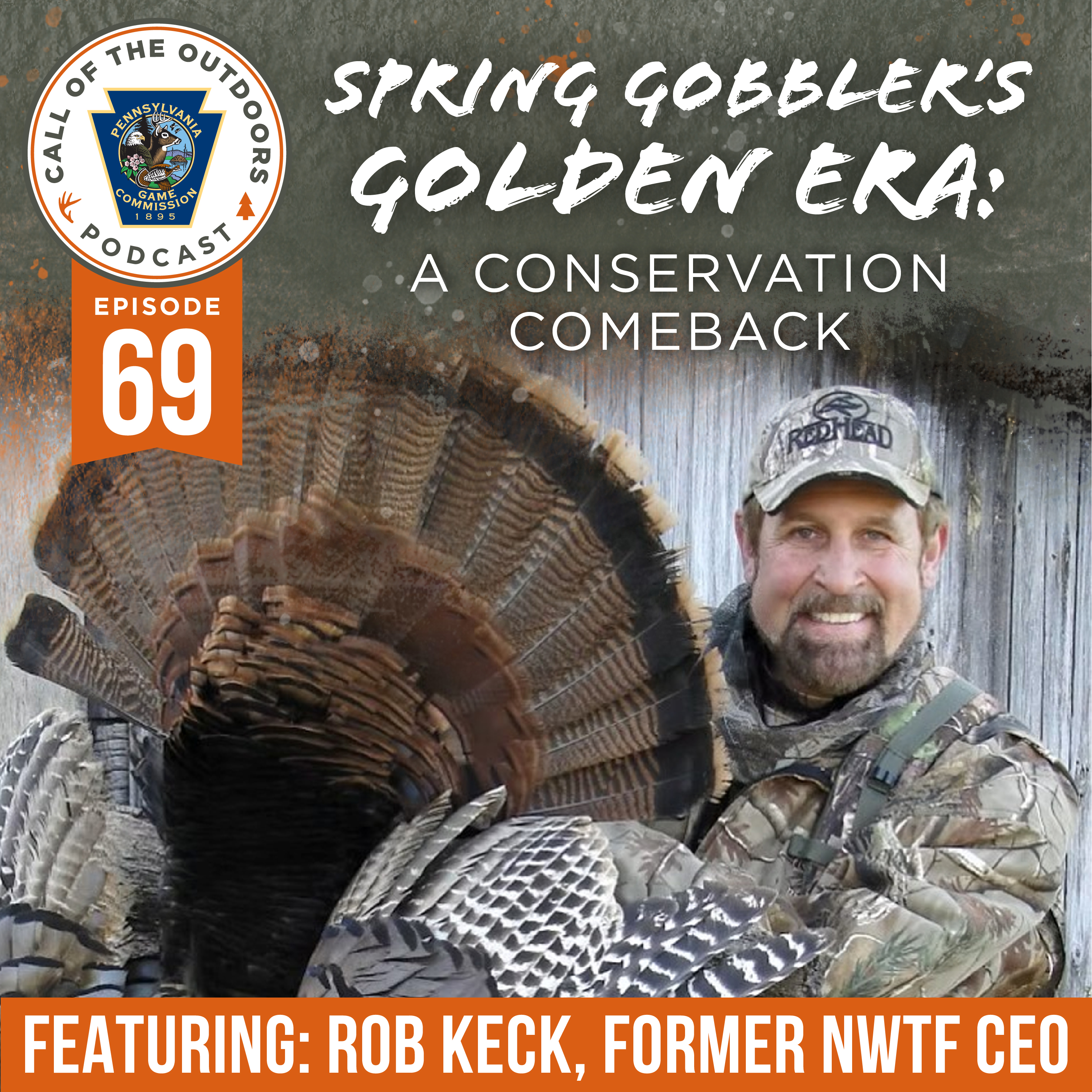
[00:00:31] Speaker B: Hello and welcome to Call of the Outdoors, the podcast of the Pennsylvania Game Commission. We have got a special edition leading up here to turkey season. We were lucky enough to be able to catch up with Rob Keck.
Rob has his roots here in Pennsylvania, being from Lancaster county and also spent a lot of time over there in Perry county and then moved on down to South Carolina to lead the National Wild Turkey Federation for so many years. There's nobody in this country that knows more about wild turkeys than Rob and we're so lucky to have him here this morning on Call of the Outdoors. Good morning, Rob. How are you this morning?
[00:01:03] Speaker A: Tell you what, if it was any better, it'd be two of me and just coming back from Florida where I just took my grandson. 15 year old Hank Reynolds.
Watched him take an Osceola. In fact a pair of gobblers right in there this past weekend. It was a youth weekend, four day weekend for the southern zone of Florida. And I'm still riding a high. I mean, to watch him know he had to really take his time on those birds because they were together. And I said, look, make sure you get a good clear shot at one turkey, not two turkeys. And anyway, he's got three legs of his grand slam. All he needs, a Rio. And we're going to try to do that at the end of May, maybe in Utah. But I'm riding a high right now, man. It's, it's springtime here and the peaches are starting to bloom and it just feels like turkey time.
[00:01:57] Speaker B: Well, we've still got a little bit to go here, but as we talked a little earlier, you know, I walked out on the porch this morning, heard some turkeys gobbling, people are seeing them strutting everywhere and you know, it's, it's, it's, it's just that time of year and it brings new life. And you know, our folks here in Pennsylvania, as you well know, Rob and I want to talk about your roots that are here in Pennsylvania. Get Excited about turkey season. And if you will know, for a lot of our audience out there, you know, not OGs like myself that, you know, grew up watching you and, you know, obviously you're one of my heroes out there and really responsible for a whole lot of what we see today in turkey hunting. But let's talk about Pennsylvania and your home.
[00:02:40] Speaker A: Sure. Well, happy to do that. I mean, I can tell even though I've moved to South Carolina to come and work for the Wild Turkey Federation back in 78, that Pennsylvania Blood still runs strong. And I come back there every spring and you know, with me it started at an early age, you know, back in the 50s and 60s, ringnecks were at their heyday in south central Pennsylvania. And I could walk from the house and we could hunt. I mean, we could hunt just forever and have just some great ring neck hunting. But you know what? There were no turkeys back then.
None. And if you want to hear or see turkeys, you had to go north. And way back in those early days, you know, I'd wait for my, you know, before I was 12, before I could get a hunting license, I'd wait on the porch for my dad and my granddad and uncles to come in and looking for that bulge in their game bag and see those ring neck feathers sticking out of the back. But you know, when they came in, they told about the hunt, but it's when they started talking about going up north. There were turkeys up in north central Pennsylvania, northwestern pa. We had a camp up in Lycoming County.
That's what really captured my attention. In fact, when I was 8 years old, all I wanted was a Louis Stevenson box call out of Wellsboro, Pennsylvania. And where I saw that was on call the outdoors, when Harry Allman was host of that great show, WGLTV Channel 8.
And it really piqued my interest because when, when folks talked about turkeys, they were like at a different level. It was different, even different than, than hunting whitetails. It was different than hunting ringnecks and rabbits, which is pretty much what we did back then.
And so it was back in 1963, we had planned, my dad and my granddad, we were going to camp for fall turkey hunt. And of course back then that's all we had in PA. We didn't have a spring season until 68.
And so we were going up and I can remember, man, it was Friday. I was just, man, I was so anxious. I couldn't wait because we were going to drive to camp that night, hunt the next morning.
And then news came across the loudspeaker that President John F. Kennedy was assassinated. And it was like, just put a wet blanket over everything. And, you know, I didn't know, gosh, are we going to still go hunting, you know, the next day? And when I got home, dad, my granddad, I said, yep, we're going to camp.
And so it was that next day, dad and I, we were on one side of Pleasant Stream, which flows into the Lycoming Creek, and on the other side on Sullivan Mountain, my granddad and my uncle were hunting.
We didn't get into anything, but late in the morning, we heard some shots over on Sullivan Mountain and pretty much guessed it was my granddad and my uncle. We came back to the camp midday, we hooked up with them. They'd each killed a turkey. They told us where the break point was. So dad and I, we headed over there and I had that Louis Stevenson box call with me, and dad let me call. And it wasn't long that we were set up. And I heard the yelp of a turkey. At that time, I didn't know whether it was a hen or a gobbler. Just a turkey was answering me.
And all of a sudden I could hear him coming through the leaves.
And then I saw him. And I had a savage single barrel, hammerless 12 gauge with a modified choke and had some high brass shells. And when he stuck that neck up, I got my first turkey. And, boy, I'll tell you what, that sent me on a trip throughout the rest of my life that had such an impact.
And it all happened right there in Pennsylvania on Sullivan Mountain in 1963.
Well, it went a while before I killed my next turkey. And it was school and obligation was sports. It was hard to get off. And anyway, it was in 69. Carl Brown and I, we're going to Millersville State College at the time, and we're in the library. And instead of studying, I was reading Outdoor Life magazine. Charlie Elliott had written a story about Alabama, longest spring season in the country. And they were hunting them before they even had a season. I said, carl, look here. I said, and Carl was out of Clearfield. And we became good buddies because we both loved to hunt.
And I said, look here, spring break is right over top of when the season opens down in South Alabama.
I said, let's go to Alabama. You know, everybody, all the kids were talking about going to Florida to party. Well, we were going to Alabama to party down at the Horse Stump Campground on. Along the Weigufka Creek on the Coosa Wildlife management Area. And it was there that I got to kill my first two spring gobblers. And spring hunting was brand new in Pennsylvania and started just really the year before. And so, man, I was just all ears to learn. And I happened to run into a guy that became friends with guy named J.D. prickett. And he ran a snuff can, a nickel snuff can, and really had an impact on me. Showed us a lot about scouting for turkeys. I never knew what a food plot was until he showed me one of those and how turkeys love to use them and brought some of those skills, some of those pointers that he gave me back home to Pennsylvania. And I took and adapted that nickel snuff cannon 74.
Actually used a plastic pill bottle working at the same way as that snuff can to win the Pennsylvania State turkey calling contest.
[00:08:29] Speaker B: Nobody ever knew what that was probably back then up here.
[00:08:32] Speaker A: Well, not really. I mean, there weren't people, you know, utilizing those. And I couldn't find any nickel snuff cans in Pennsylvania for whatever reason. And so I got a plastic pill bottle that was about the same diameter and size as what that nickel snuff can was.
And it was amazing. I still use one today. Still use it? Yeah.
[00:08:55] Speaker B: Well, your story, I mean, it just gave me goosebumps because it's a lot. Mine's about the same way with fall turkey hunting. And you know, obviously nowadays, you know, a lot of folks are using dogs. I tell all my friends, like, I used to be the dog when I grew up, because that's what we did. I mean, you know, we chased around the woods. But you were telling me earlier about the turkey on the wall behind you, and that's pretty special story. I think that needs to be shared.
[00:09:19] Speaker A: Well, it was in the spring of 74, I think it was.
It was that first week of May and we had one of those freak snowstorms and my dad and I were hunting together. We were up Pleasant Stream right at short run, and I made this turkey gobble. Couldn't believe I made him gobble because it was snowing hard and there was already like 6 inches snow on the ground.
And so we set up and I mean, he just gobbled at almost every step coming into us. And I wanted dad to kill him. And unfortunately didn't come around the side of the tree where dad was sitting. And he whispered, he said, you take him if you get a shot. So when he came back around on the right side, I killed him. But I could hear him drumming coming through that snow. And to watch him strut in the snow was like bizarre. I mean, I'd never seen anything like that. And you know, oftentimes people say, well, you know, it's too cold or snow wouldn't gobble. Let me tell you, he broke every rule, every thought that anybody ever had, what cold weather and snow might do to them.
And, you know, I was just so taken back by. By that gobbler that I wanted to. To mount it. And I couldn't afford it back in those days. And so I decided, I went and looked at some books on how to skin and mount birds. I thought, going to mount this. And anyway did so. And anyways, on the COVID then the American Taxidermist magazine, I think, spring of 75.
[00:10:51] Speaker B: Wow.
[00:10:52] Speaker A: But anyway, it was just one that's stayed with me. I've. Everywhere that I've lived, that bird has come along. And just a reminder of one of the great times that I had shared with my dad.
And it was all right, there were. We hunted in Lycoming county of Pennsylvania.
[00:11:11] Speaker B: Right.
[00:11:11] Speaker A: You know, my first.
[00:11:13] Speaker B: Oh, go ahead. I was going to.
I was going to say, you know, when you talked about growing up and lots of pheasants and, you know, I've kind of missed that era in my life. But you grew up in Lancaster county, correct?
[00:11:25] Speaker A: I did, I did. I. And after I graduated from Millersville, I taught school for one year in Lancaster, John F. Reynolds. And then I had some turkey calling buddies in Perry county. And they said, there's an opening in the art department up there. Why don't you apply? Well, they gave a little strong arm to the superintendent and I got hired in Perry county. And that is where I got a real turkey hunting education, a turkey calling education.
I mean, it was the hotbed of turkey interest of turkey call manufacturers, people like Chet Lesh. I mean, here's a guy that.
He had a great impact on me, the ability of him to make calls there in his basement. I mean, he taught a lot of the guys that became very famous in call making years after they'd come and sit in the basement next to Chet and he would show you how to stretch rubber, how he took a nail and peen that frame and, you know, got the rubber into place.
And he had a great, great impact on me as well. But people like Wayne Coke Anderfer, he was another guy. That Cokey was a guy that told me an awful lot about turkey hunting. And one of his great friends and a guy that became a very, very close friend of mine was Fritz Fleischer and the Fleischer brothers. In fact, there was three of them, Bud and Glenn and Fritz or George. And they called competitively, but George was the tinkerer. I mean, he was the kind of guy that was always trying new things to make calls. End up Penn's Woods Products out of doma, which at that time was the largest call manufacturer.
They took some of his designs and they became part of the line of. Of Penn's Woods Products.
But, you know, I look at the origin of things like double slates. You know, oftentimes Dee Dee Adams is given the credit for putting, you know, two slates together. But actually it was George Fleischer, and Fleischer and Dede were good friends, best of friends. They just lived across the mountain. Dee Dee lived in Juniata county and. And Fritz in Perry county, outside of Millerstown.
And it was him putting those two slates together gave this unique sound, a pot call.
And Dede was a machinist. He was a. He was a real technical guy. Fritz was just the kind of guy that he was trying, you know, putting things together. They weren't necessarily the prettiest, but he found the answers to some of the things that we were so concerned about. And as far as trying to imitate a turkey and, you know, I look at the innovation in that family, Glenn Fleischer, he was the first person that I knew that had put multiple reads together. I'll never forget when he called, I forget what contest it was, but he had a sound that nobody had ever heard before.
And having worked the calling circuit as I did, I mean, I knew about what everybody was using.
And nobody was using multiple reeds back there in the early and mid-70s.
And Bud is the guy I credit with putting the first multiple read double reed collar together. And then, of course, since that time, all kinds of variations. And God rest his soul, you know, he was one that was killed in a turkey hunting accident or incident, as you might call. And it's just, you know, it's. It's been something of a. Of a tremendous learning experience of how to be a good hunter, a defensive hunter. And I think that Glenn's death, along with many others that were shot in those early days at unacceptable levels, that helped me, when I was at the Federation, create what we call the Turkey Hunter Safety Task Force, and has had an impact. Now, where you virtually hear of no turkey hunting incidents were back in the 70s. I mean, there'd be 25 or 30. It was amazing.
And, you know, it took the death and the Injury of turkey hunters to help us find solutions on becoming good defensive turkey hunters. And don't put yourself in a position, just like being a good defensive driver, that you could draw fire from another hunter. But Perry county meant the world to me as far and still does with so many of the guys. I mean, whether it was Jerry Schumann, whether it was Dick Smith, you know, the Fleischer brothers, and of course the Roms, I mean, Terry and Robbie and Put and Dale and you know, spent many, many hours with them. You know, their call making abilities and all that they've done.
Just a great piece of history. And the impact of Perry County, Pennsylvania on the rest of the country is something that a lot of people just don't even realize. They don't realize where a lot of these calls and, you know, the way they're utilized came from. And Pennsylvania can take great pride in that.
[00:16:42] Speaker B: Absolutely. And it's funny you say that. I grew up in Linglestown and moved to Perry county. And for that reason, because I always wanted to be from Perry county because of you guys. And the funny thing is you mentioned I live on the eastern side in Marysville. And you know, your part of the world doesn't consider that Perry County. But Putt and Dale and a few other guys up there gave me my
[00:17:07] Speaker A: official
[00:17:09] Speaker B: id, Perry county id. So they have finally officially recognized me for living in Perry County. But you said so many things, Rob, that bring back memories. I do have a question.
When you were talking about waiting for your dad and your uncles to come back from hunting, because I remember doing the same thing, did you have a red rider in your hand when they came back?
[00:17:29] Speaker A: I think I had a red rider and I actually would wear, you know, when it was in November, it was in small game season, my grandpa had a porch swing and I would sit there and I would wear his wool rich coat because it'd be cool in the evenings when they come, you know, his red and black wool rich hunting coat. Right. And I just felt like I had to be part of, you know, the whole experience.
And you know, one of the things that helped me cope with that, because I wanted to go. I mean, When I was 5, 6, 7, I wanted to go in the worst way.
And trapping is what helped me. And Pennsylvania game news, let me tell you, I read it religiously. That was one of the things that I always wanted. And my mom and dad gave me a subscription to that. And I still don't think I've ever missed an issue. But in those early days, there were many, many Articles on how to trap, whether it was trapping muskrats or coons or foxes or what have you.
And that was my way to connect and being able to, you know, be a participant. But it was those early years that impacted me when I was at the federation, said, look, we're going to get rid of these minimum hunting ages that when I moved to South Carolina, I saw kids 5 and 6 holding their first turkey, their first buck, you know, their first squirrel or duck.
And I said, man, I was cheated out of some years of hunting.
And you know, it really gave me the drive to help move that ball forward. And not only Pennsylvania, but we changed the laws in, gosh, 40 some states, two and a half million new young hunters mentored hunters that came about as a result of legislation. I mean, it was really a proud day for me to introduce Governor Rendell at the bill signing ceremony where, you know, we got rid of that minimum hunting age. And it was amazing. It was 202 to 1 in the house that it passed unanimous in the Senate. The governor signed. The governor said that was the fastest moving bill he had ever seen go through the legislature.
And you know, you think about all the young people since that time that had a chance to, to, to hunt for the first time and what it's done to embed them as long term hunters, licensed buyers in the state of Pennsylvania. And you know, that's just, you know, people ask me, you know, what do you look at as you look at your past history and conservation of being, you know, sticking out as being important? That was one of them.
[00:20:09] Speaker B: Sure.
[00:20:09] Speaker A: Creating those new hunters, because hunting is conservation. They're the guys that are paying for these things that we really deem important, whether it's management, whether it's research, whether it's restoration or what have you. And so that to me is just one of my great, great thrills of having been able to, to lead that way and to provide more opportunities for hunters there in Pennsylvania.
[00:20:35] Speaker B: Well, on behalf of myself, our agency and everybody else, I mean, we can't, we'll never be able to thank you enough for, for everything that you did in, in that, that space or any, I mean, all of the measures. And you know, obviously I'm sure someday you're going to write a book about everything that you've seen happen because you've seen a, you know, from 19 in the 60s growing up in Pennsylvania to where you're at today. But let's talk about when, when you left, when you left Perry county and went to work for the National Wild Turkey Federation and how that came about.
[00:21:09] Speaker A: Well, you know, I was riding high at that point in my life in the mid-70s.
You know, I'd won the Pennsylvania State calling championship, I won the US Open, won the world, and I got to know a lot of people in the turkey world, that little mouth call. In fact, I said, I'm going to write a book about where this call has taken me because I look at our industry and I think about where guys that have really reached high levels of success and they got their start with a turkey call.
And it was that that introduced me to a lot of the people at the NWTF, the board of directors. I remember 75 at State College with Roger Latham and Frank Piper. And as we formed that very first Pennsylvania State chapter at that meeting.
And anyway, as time went along, I was doing seminars and clinics in addition to teaching school, I was also working as program director for Penn's Woods Products out of Delmont.
And anyway, the president of the board of the NWTF contacted me and said, look, we've got, we've got a convention that's going to take place in Hershey, Pennsylvania, 19 in February of 77.
And would you help us put together a nationally recognized turkey calling contest? And I said, sure, I'd be glad to do that.
And so I created the Grand Nationals, which continues of course today and 49th time it ran this, this past February in, in Nashville, Tennessee.
And you know, it was there, the, the excuse me, that things really started to launch in my career.
Gene Smith, who was editor of the magazine, he asked me to write a column. And again, I still wasn't living in Edgefield, I still wasn't an employee, still teaching school.
And then the chairman of the board came to me and said, we've got an opening in Edgefield and we'd like you to come interview for the position.
Well, they didn't interview anybody else.
And I said, I got to think about it. I said, well, in December 76, we've got a board meeting in Pineapple, Alabama at Brooks Holloman's camp. He said, you can come down there and you can fall turkey hunt and deer hunt. And that's all I had to hear to come down. And then they pitched the job and I said, give me two weeks. So I came back, I talked to my mom and dad.
Dad was very supportive. Mom wasn't so sure she didn't want me to move out of pa. Sure. But she finally, finally joined in supporting. And then I talked to the superintendent, school district and that's what really helped me make the decision.
You know, the federation was sort of floundering at that point, and I'm thinking, what would I be leaving behind to go down there?
And the superintendent said, rob, we don't want to see you leave. But you know what?
If you want to go, try it during that first year, if it doesn't work out, he said, we'll find you a job in West Perry School District. I said, wow, thank you so much. And so January 31st, I loaded the truck, headed south. February 1st of 78, I was pulling into Edgefield, South Carolina. I left three feet of snow, and when I got down there, the peaches were blooming, and it felt like spring. The birds were singing.
And it was then that I had to make a decision on where to go, how to make this thing work, and roll my sleeves up. And so that's where I got that start with the federation and looking at it on a national scope.
And it was one that, you know, took me to a lot of places, met a lot of people, you know, through those years, you know, their conservation leaders, other turkey hunters that wanted to put more back than they ever took away.
And during that time, got to sit with some very influential people. In fact, I met during that time and since then, five different US Presidents and was able to talk conservation with them.
And, you know, that little turkey call. It took me to be with Olympic champions, NASCAR champions, governors, so many different people that all had an interest in putting something back in conservation. And so at the federation, I just continued to do what I loved to do, and that was to thrill over what it was going to take to bring back the wild turkey to so many parts of the country where they were going. When I started, There were only 30 states with the spring turkey season.
And, you know, even in Pennsylvania, we had a real challenge there with the game farm.
And, you know, there were places in the southwest, down in Green and Allegheny county, and up in the Northeast, up in Susquehanna county, where they were putting penrood turkeys.
And we had to really come to grips with the fact that trap and transfer was the only way to go. And, you know, we're able to collectively, as a team, make an impact. And some great decisions were made. And, of course, you know, how the turkey is now thriving in all those places once wild, trapped birds got into those areas.
[00:26:40] Speaker B: Let's talk about that, because, you know, we're living a time, Rob, where a lot of folks don't remember the past. And, I mean, I know you do, where, like, people get discouraged when they go out and don't hear a turkey gobble. I mean, I can't even tell you. Like, I grew up obviously in the 70s and 80s. Like, you heard a turkey gobble. You hunted him a lot. You hunted him most of the season because there weren't turkey, the population wasn't what it is today. And let's talk about, like, Target 2000 and, and things that have happened in your career where we're seeing the popula, like, we're living in the very best times. Sure. There's, there's cyclical differences, and, you know, we're seeing a ton of turkeys right now in a lot of places. And I mean, things are really good.
[00:27:24] Speaker A: Well, I think we have to recognize we live in the golden age of the wild turkey. There's no question about that. You know, when I look back, as I mentioned earlier, you know, in the 50s and 60s, there were a lot of parts of Pennsylvania that had good habitat, but no turkeys.
But another thing that has changed was the definition of good habitat.
Because down in the Southwest, it was considered by our biologists back then that that was marginal or sub marginal habitat.
Well, it turned out it was some of the best we had, same way up in the Northeast.
And so trap and transfer took place. Once we got that, the game farm closed down and wasting, you know, just millions of dollars on something that was nothing more than cannon fodder. And, you know, we got aggressive with that. It was amazing how fast the wild turkey took over in these parts. And, and the word adaptability was probably the, the key word that, you know, these turkeys were adapting to a lot of different habitat types.
Well, you know, I, I remember Jerry once, and, and he was a great, great biologist, great friend. And, you know, he said, Rob, back. It was back during that time, you know, in the 60s and 70s, he said, prime habitat for turkeys was 10,000 acres of mixed pine hardwood timber.
Well, in the years that came after that, we found that that wasn't necessarily the case, that openings became very, very important. In fact, it increased turkey density significantly. And I remember going to Jerry and saying, look, Jerry, the Lower Susquehanna River Valley, York County, Lancaster County, I said, has some prime habitat. We ought to be putting birds down there. And, And Jerry said, rob, no. He said, there's. There's too many people down there. I said, well, Jerry, I have been to eastern Iowa, I've been to Wisconsin, all along that Mississippi river drainage, Illinois. And I said, they've got high fertility. They got great riparian areas, lots of agriculture, and those Turkeys. Well, they've got some of the highest densities of eastern turkeys anywhere. In fact, Stephen, state forest area in eastern Iowa, less than 4% of the area has timber, had the highest density of eastern turkeys anywhere in the country.
And Jerry just. He. He was still hanging on to this 10,000 acres. And look, they were doing the best they can because the turkey's been proven all of us wrong for so many years. And it took him retiring and Mary Jo coming on board and, you know, taking over in Jerry's shoes and a new director. When Verne Ross came in, I got with Vern and I said, vern, there are some great unoccupied habitat in south central Pennsylvania. And I said, we ought to be putting birds there. And Mary Jo agreed. She looked at that habitat. And so we took turkeys that were trapped up north, brought them down to Muddy Run, and released them, and released on both sides of that Susquehanna river in both Lancaster and York counties. And let me tell you, they just exploded. And, you know, once again, the turkey proved even the best thinking of wildlife management, that they can go beyond what anybody thought they could do.
And so it was a thrill for me to see turkeys in places where I grew up, where there were none back then. And I'll never forget, you know, the first one I killed in Lancaster county was.
I was down at Safe harbor, and I was in some PP and L land. It was public cunning. And I killed a gobbler, and I looked down over the hill and across the Conestogee Creek, over into the ball field where I played midget baseball. And I thought, man, what an opportunity this has been. What. What a story this has been to go from no turkeys, being able to come back here and hunt them where I played baseball as a kid.
[00:31:35] Speaker B: That's awesome. A proud moment for you, too. I. My daughter lives in Northern York county, and just this morning, I got a text of a wad of turkeys out in the field. She said, dad, there's five longbeards here. So it has definitely changed, because I remember those days as well, where there wasn't many turkeys off of the mountains.
And even where our office is, where you've been many times, I mean, it's not uncommon to see a strutter across the street right outside of downtown Harrisburg, which is just incredible.
[00:32:09] Speaker A: Well, you can see them all throughout Lancaster County. I mean, they're coming right into the residential areas, and they've just adapted extremely well. And I look forward each spring coming back to be able to hunt A turkey in York county and Lancaster County. Even though I love the north, I love hunting in the mountains because I used to think that's the only place you could kill a turkey. And it works.
But to be able to come back home says an awful lot.
It's soothing to the soul, and to be able to share it with cousins and friends is just very, very special to me.
[00:32:44] Speaker B: Let's talk about something that's more recent in your career, and that's your trip to Canada, your Canadian quest. And I just saw Outdoor Life.
You sent me the link, and I watched it the other day. It was pretty amazing.
[00:33:00] Speaker A: Well, I've always liked to break new ground.
I like to attack new frontiers, to see what's out there, and I've always been that way. It's just part of my makeup.
And back in 99, well, even I'll go back further. Back in the late 80s, we at the federation put together a symposium at the invitation of the Province of Ontario. And we had seven different states that attended. And they delivered papers on the wild turkey in their states, the kind of habitat they had, how they've done, et cetera.
And so after that symposium, each one of those states donated turkeys to the province of Ontario. And they just took off like gangbusters. They already had some. They were coming across the Niagara river from. From New York, and it was just, you know, just another one of those success stories of expansion and. And then introduction and reintroduction. And so in 99, I went to Ontario and.
And killed my first two Canadian turkeys. And, you know, it was pretty cool to be able to do that because I had hunted them in Mexico. I thought, man, be able to take turkeys in three different countries, that's pretty special.
Well, then I kept track of these turkey movements. And I remember back in those old days, the original range map showed the wild turkey just coming up to the southeastern corner of Maine. And biologists said, well, they'll never go any further than that. Well, the turkey once again proved even the best minds wrong. And they just continued right up to the New Brunswick border and expanded into New Brunswick. And I had a call from my friend Terry Smith, who was president of the Canadian Wild Turkey Federation. He said, rob, we're going to allow non residents to hunt this year. This was two years ago.
And he said, you've got to buy a tag, though. You can only do it through an outfitter. I said, well, sign me up, boss. I'm coming.
And it was amazing. It was like the old days. I mean, turkeys Everywhere, and everywhere you turn you could hear a turkey gobble. And it was just one of those things that really piqued my interest now. And where else can I go in Canada?
And so Terry put me in touch with another good friend who's become a good friend, Steve Tardif from Quebec.
And he told me, said, rob, turkeys are everywhere up here. In fact, just a couple weeks ago, he called me from a spot. He said, rob, I am over 500 miles north of the U. S. Canadian border.
I'm in three feet of snow, I'm snowshoeing and there's turkeys everywhere.
I just, I couldn't believe it. I told Terry Smith, and Terry said, look, I outfit bear hunters. Turkeys now are at the far northern extremes of New Brunswick. He said, I've got bear hunters that are sitting on bear baits with.
They're taking their cell phones and their video and turkeys coming right past their stand.
And I thought, okay, I know that British Columbia has tags available over the counter, just like Ontario and Quebec.
And I thought, where else can I go? Well, Manitoba has a season, but it's residents only.
And Alberta the same thing with one exception. They've got what they call the ministers turkey tag.
And I saw that it was on auction at the Western Hunting and Conservation Expo out in Salt Lake City. I went online and started bidding on it, ended up getting it. And this allows a non resident to be able to go there. So I thought, man, I've got it lined up now. So anyway, OUTDOOR life was really interesting because they did a story about when I finished the 49 states, the first one to take a turkey in every state that had a season, Alaska being the only exception. And so they wanted to record this for the Canadian Wild Turkey Super Slam, which is the name that the Canadian Wild Turkey Federation gave. And so my plans were to go to Alberta and hooked up with a great outfitter and become a great friend, Lindsey Patterson. He's a big trapper and anyway, had a great hunt there. And so we just went across the border into British Columbia.
It's really funny. We were in a coffee shop and we had our camo on and walked in. There was four old gentlemen. They're having a cup of coffee and some breakfast. And they looked at me and said, what are you guys hunting now? I said, turkeys. He said, well, I wish you'd come to my place and kill every one of them. I said, well, we're not going to do that, but if you tell me where your place is, I'll try to fill one of my tags.
[00:37:50] Speaker B: That's a wrong thing to say.
[00:37:52] Speaker A: Yeah. And so we found a lot of opportunities in British Columbia. So I took the Alberta and British Columbia bird and then in May went to Quebec with Steve and was able to take my Quebec turkey, which then took care of that super Islam, which was five provinces.
And while I was there, Steve said, look, Ontario's not that far. Let's go. You need to kill another Ontario turkey. And so we hunted there and took another bird there. And so anyway, it's been just a thrill for me to be able to break new ground, new opportunities, because most people don't think about Canada.
And, you know, there's a lot of turkey hunters in Pennsylvania that are branching out. I mean, they drive to Alabama or go out west of Montana. Well, you can go north to Canada, you can go to Ontario, you can go to Quebec, you can go to New Brunswick, or you can go to the other side of Canada and go to British Columbia. And I know a lot of guys that are going and they're hunting Washington State, Idaho, Montana, then they're hopping across the border and hunting British Columbia, and those birds have just exploded.
Interesting story on B.C.
back when I was at the Federation, we offered birds to the ministry there in British Columbia and they said were non native, we really don't want them here. I knew the habitat was good, so we took and released birds right on the Washington State British Columbia border. Well, guess what? The turkeys just took off and now they've expanded. You can go three hours north of the BC US Line. And I've got friends up there said we're seeing turkeys everywhere.
So it's a great story, and it's a great story of how they've adapted to so many different types of habitats and climates and living in places like the boreal forest where 30 years ago they said turkeys had never lived there and they're thriving.
[00:39:51] Speaker B: Yeah, and that's, that's one of the issues that we have a lot here at the Game Commission is when we talk about habitat. And, you know, a lot of our folks don't realize how the habitat changes drastically. I mean, I'm sure you walk by or walk into some of the woods that you hunted in the 90s, it doesn't even look like the same place today.
And the way that the turkeys do adapt is amazing.
[00:40:16] Speaker A: Yeah. You know, one of the things that I have said for quite a long time, if there was one major thing that landowners or Pennsylvania State Forestry or the Game Commission on public lands is to create more openings.
Those openings are vital for turkeys, and it's vital for brood habitat. It's. It's vital for. For them to be able to. To prosper and do well, as we have seen in so many of the upper. In the states of the upper Mississippi River Valley. And so I would encourage anybody that's listening here to this podcast to say, you know, are there some places where we can put more openings in and then plant the kind of things that are not only good for turkeys, but for elk, for whitetails and a variety of other wildlife species? And it's just an opportunity there that I think we can increase carrying capacity in a big way. I mean, there's so many openings, you know, and I saw it when I lived in Pennsylvania, the number of times I found gobblers at gas wells.
They liked those openings to strut.
[00:41:27] Speaker B: Man, we gotta stop this podcast, right? You're giving away all the good secrets now.
No, but when you're talking about that, if you look at the elk range that we have here around in that north central area, where there's a lot of habitat work going on creating openings for elk, the turkeys have responded. Incredible.
[00:41:48] Speaker A: Absolutely.
[00:41:49] Speaker B: It's pretty amazing.
[00:41:50] Speaker A: It's not a surprise at all to me.
And I've just. I've seen it in so many states when those openings are improved and, you know, added to the land area, the turkeys just do extremely well.
[00:42:05] Speaker B: And, you know, we here at the Game Commission, obviously, we can only control our gameland system. And for, you know, private landowners, it's such an important message as well, because it is definitely part of our plans, you know, on all of our management plans on our gameland system, and, you know, a little bit background for that for you, too. We are almost on the verge of having a state game lands in every county in Pennsylvania. We've included Philadelphia and working on the last remaining county right now to have a public hunting state game lands in that county. So that's. That's a pretty impressive feat as well.
[00:42:45] Speaker A: It is. Congratulations to the Game Commission on making that a priority because this is what we're going to hand to our children. That's right. Those opportunities.
And we all know the challenges that we face having the opportunity to go on public land and to be able to have a great experience as you and I have had throughout our years.
It is so, so important. So my hat's off to all of you at the Pennsylvania Game Commission for the work that you've done to try to provide those Opportunities. It's all about having the place to go, the access to those places that will make a difference in the future.
[00:43:31] Speaker B: Well, Rob, you know, we, we want to catch back up with you here when you're back up in Pennsylvania. But for our turkey hunters that are getting, you know, they're foaming at the mouth right now because season's about ready to start. But let's talk about the hunting side of things. And obviously you've hunted turkeys all over the world, and you come back to Pennsylvania, if you could help our folks out there with a couple tips, you know, you already gave one away about those openings and gas wells and things like that. But, you know, something that you've learned that maybe a lot of people don't think about or something that's just the golden rule from, from your side.
[00:44:07] Speaker A: Well, I can tell you one thing. I was reading this morning a report from one of the companies. I forget what it was, but they were interviewing outfitters.
And one of the most common problems that outfitters encounter is that people, turkey hunters, don't understand point of aim and point of impact of their shotgun.
And so before you ever go out in the field, you need to take time and understand how that gun is going to pattern at different distances, but how you're going to aim it. You're taking a shotgun that you would normally point and swing through the target if you're hunting waterfowl or if you're hunting ring necks or you're hunting any kind of bird.
But now you're taking that shotgun and you're using it like a rifle.
And I would strongly advise that you have some kind of sighting device, whether it's open rifle sights, whether they're true glow sights, whether they're a red dot, whether it's a scope. But you need to understand that when you are looking at the target, that you do have your cheek buried into the comb of that stock and that you know how that load is going to perform at different distances and that you can hit the target.
It seems so simple, yet there are so few that take the time to do it. So I would encourage everybody listening, everybody watching.
I mean, I just did it again yesterday. I'm constantly doing that because without that, you can make mistakes a lot more easily.
And these outfitters that we're talking about with hunters, I mean, they spend all this money to hire a guide and an outfitter and their travel and their equipment and preparation, but they don't take the time, pattern that gun and understand point of aim and point of impact. So that's number one. I would take care of that immediately. Secondly, know where you're going to hunt.
Having intimate knowledge of the place where you're going to go is, is very, very important. But let me caution you on one thing.
If you go like a couple months before season, you're really just understanding the lay of the land.
But the best scouting is the week or two before the season opens. Because when you look at mid March, those flocks, those wintertime flocks are dispersing. And winter range does not necessarily mean spring range. I can't tell you the number of landowners that I've talked to over the years. That said, man, I had turkeys on my place all winter long and came the middle of March they're all gone.
And those hens are out there looking for nesting habitat, places where they're going to have brood cover or they can bring those pulse off. And so to me there's two different elements of scouting. Scouting to learn the lay of the land. Know where the barriers are, whether it's creeks or fence lines, roads, those kind of things that can either hang up the turkey or help you get in a better position on the turkey and then try to find where they're at right before the season opens. Because a lot of those gobblers, you know, our research has shown that some of those gobblers may win A gobbler study in northeastern United States, ten year study.
Some of those gobblers went from winter range to spring range covered from 5 to 25 miles. So you may have watched them at the beginning of March, at one place, come the first of May they could be 25 miles from there.
And so that is the second point.
Thirdly, I would get a call that you can run easily.
You know, I was talking to a guy just this weekend that when I got back from Florida, he was wanting to know, he said, I'm wanting to, to learn how to turkey hunt. So what kind of call should I get?
I said there's probably more turkeys taken with a box call than any of the others all put together.
And I said a one sided box like the Lynch 101. I used one of those for a long time and it's so simple. And just learn how to yelp, just that double note key out on there. You can go onto YouTube and you can just get all kind of instruction. You can listen to turkeys yelping to get the cadence and the rhythm and the sound correctly. But you don't have to have a mouth call to take a Turkey. And there's so many people that think, man, I'm not a champion caller, so I can't call one in. Well, just forget about that.
Try to make sure that you. You've got a call that you have some confidence in and just practice, practice, you know, get on that YouTube and just practice and. And you can learn how to do that very, very easily.
Next, I would check all of my equipment that I take.
My turkey vest is loaded with things that aren't necessarily calls. For example, a clippers. That's one of my most useful tools to trim limbs and briers and bushes or what have you. So that when I set up, I've got a clear shot on where I think the turkey is going to come in.
I've got a seat to sit on. It may be more than a cushion pad. I found that if you can sit motionless, you'll become a more effective turkey hunter. And if you don't have something to ease that pain of a root or a rock or whatever it is pushing up against your derriere, you're going to be moving. And a lot of times that turkey's not goblin when he comes in and he can pick out that movement very, very easily.
Another thing that you might want to consider is a decoy. But, you know, I grew up turkey hunt without decoys. You don't have to have a decoy, but a decoy can take some of the attention away from you, the hunter, and put it out there 25 yards in front of you on that decoy.
And there's many different decoys out there on the market, but use them responsibly.
Do it in a way that you're not going to draw fire, and do it in a way that you know is not going to be in a position, put you in a position where maybe you could draw fire from another hunter, just being a good defensive hunter, and then camouflage head to toe.
I think you can go to bass pro shops and find everything that you need, but a lot of people forget a face mask. You can use face paint, but with nothing glows in that woods more than ungloved hands and a shiny face.
So make sure you've got gloves that you can feel, feel the safety, feel the call that you can manipulate all the tools that you have in that vest and then make sure that you've got something that's going to break up that large whiteness of your, of your face or the shine, rather of your face with a face mask or face paint.
Those are just a few of the Things that will help you become a more effective turkey hunter.
But even with the best equipment, hunting in the best places, even with the best guide, there's some days that turkey just not going to give in to your calls and he's going to win, and that's okay.
We like to know that there's going to be a turkey there to hunt the next day, too.
And nobody likes hunting turkeys more than I do. But I know full well that there's going to be days that that turkey is going to win the battle and enjoy it for what it is. Enjoy that special time out there. Because when spring is coming alive, there's so much to see.
It's a time to introduce people that have never been in the outdoors, never gotten up at daylight to see a sunrise, to hear a barred owl, to hear a turkey gobble off in the distance, to hear a hen that's calling and tree calling and fly down in front of you.
It's a time when you can see maybe a bear with cubs or you can see an elk or white tails and some of the songbirds that are migrating back up north.
The red buds, the dogwoods, the beauty of spring. It is just one of the great times of year to be out there in God's green earth, God's creation, and really appreciate this gift that we have and this opportunity to hunt in this land of the free.
[00:53:01] Speaker B: I don't know how we can end it better than that. Rob, again, from everybody here at the Game Commission, thank you for joining us this morning, and best of luck to you for the rest of the year. But we are going to catch up this spring for part two and talk a little bit more on the conservation side. But thanks for getting me. I got goosebumps right now thinking about it. Ready to turn my truck south and start turkey hunting. But, I mean, you hit the nail on the head on everything.
And just our gratitude to you for everything you've done in your career for hunting, turkey hunting, just everything that you've done for conservation.
You know, it's. It's pretty amazing from your roots from Lancaster and Perry county to. To where you've been across the world to talk about conservation. But best of luck to you this spring, too.
[00:53:49] Speaker A: Well, thanks so much, Matt, and the same to you. And to all those that are watching, enjoy what we have been given as a gift, a gift that so many people around the world don't have, and we take it for granted. And so good luck to you. Thanks for answering the call, that call to our hunting, our fishing and our trapping heritage, and we'll see in May.