Episode Transcript
[00:00:00] Speaker A: Bonus points are they act as a multiplier. As many bonus points as you have, your name goes in the hat that many times, which effectively bumps the probability
[00:00:07] Speaker B: you're gonna draw when you say 1500 conservative. We probably most definitely have 1500 elk
[00:00:12] Speaker A: don't go there in the middle of the day. That is absolutely the worst time to go there. Elk are crepuscular, and all that means is that they're active during dawn and dusk.
[00:00:26] Speaker B: Hello, and welcome to Call the Outdoors, the podcast of the Pennsylvania Game Commission.
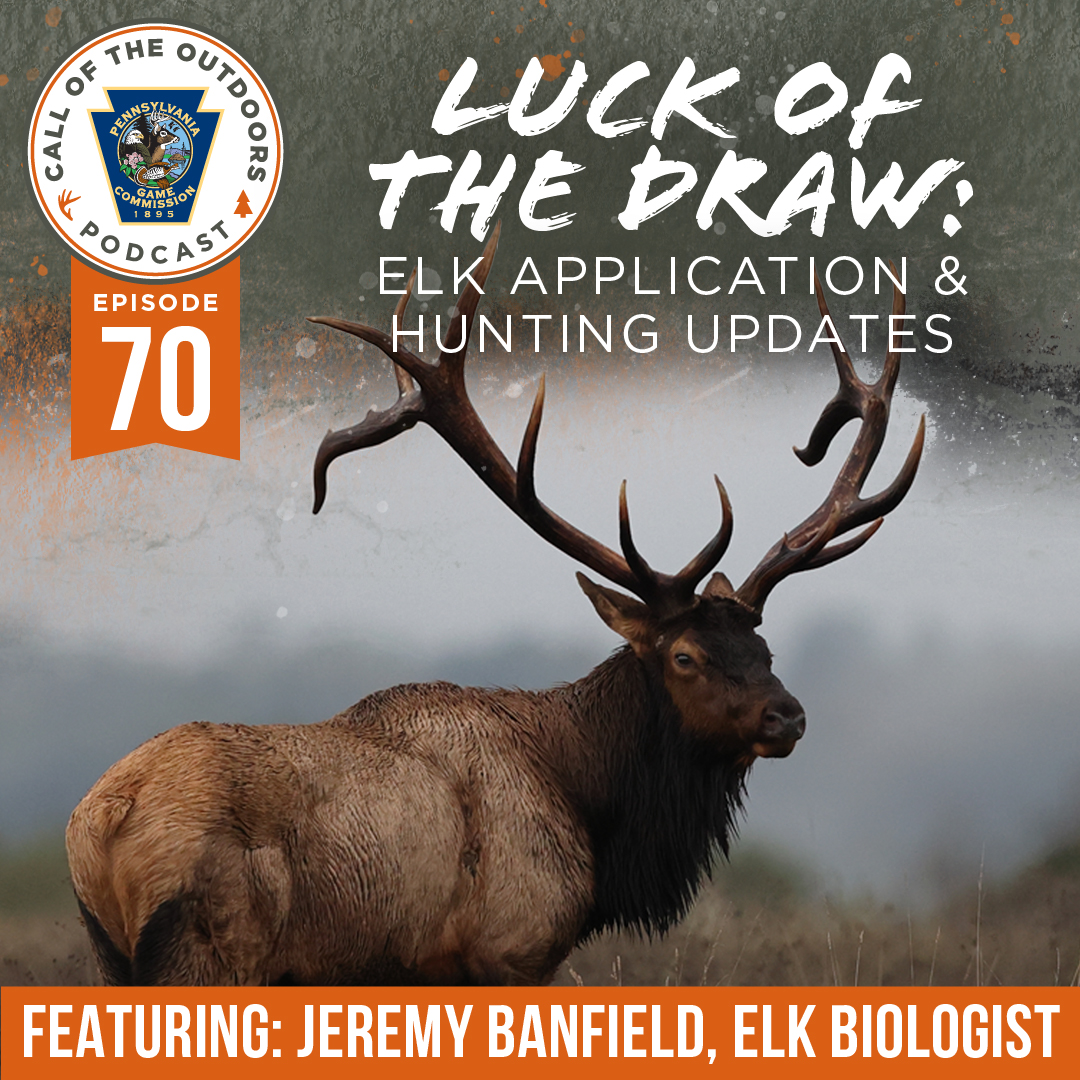
You know, we're here today. It's the middle of turkey season, but we're talking about elk. We have a lot of changes that happen for this. This upcoming elk hunting season, and we're bringing Jeremy Banfield, our elk biologist, down to talk about it. There's a lot of different opportunities. We have more bull tags out there this year, and we're going to discuss them all. But thanks for joining in. And we're talking about elk today here on Call the Outdoors. Well, Jeremy, thanks for making the trip down from elk country. And speaking of that, what's going on in elk country right now?
[00:00:56] Speaker A: It is spring, so critters are losing their winter coats. They look real shaggy right now. Mommies are getting ready to have babies. That'll be right around Last part of May 1st part of June, and otherwise it's pretty quiet up there.
[00:01:08] Speaker B: Well, turkeys are gobbling, though.
[00:01:09] Speaker A: That is true. Turkeys are gobbling. Yep.
[00:01:11] Speaker B: And it's amazing to me that, you know, the habitat work that's been done up there for elk herd, how it benefits all wildlife up there, and it's just turkeys being close to my heart, and people probably tired of me talking about them. But, I mean, the turkey population, that part of the world is pretty strong.
[00:01:28] Speaker A: Yes. And it's pretty cool to be hunting turkeys while you got elk running around, too. Sometimes they bust you and mess you up, but it's still fun.
[00:01:33] Speaker B: Yeah, that's. That's. That happens. But anyway, you know, when you're looking at you talking about our herd here in Pennsylvania, obviously we're here today to talk about it's coming. I mean, you know, we're getting ready to May 1st we start selling elk applications, which is new this year. We have a lot of new stuff to talk about, but in general, let's. Let's just talk about the herd. And, you know, you just came off a board meeting, and I know you can do in your sleep, but let's just talk about where we're at today with the L Kurd here in Pennsylvania.
[00:01:59] Speaker A: Yeah. So roughly 1500 animals. You know, that's a conservative estimate. We do an aerial survey every year. Number was like 1563 with some confidence intervals around that. So let's just say 1500 animals is where we're at.
That population is growing. It's growing slowly by design. And we're hoping to see that continue grow over the next 10 years. I'll say.
[00:02:23] Speaker B: And I know your profession.
You don't live in a crystal ball world like we do. Like we make a guess and you know, in a marketing world we say they're 2000 elk. But when you say 1500 conservative. We probably most definitely have 1500 elk.
[00:02:35] Speaker A: Yes, agreed.
[00:02:35] Speaker B: Yeah.
And talk about the survey. It might interest people out there listening to how you come up to those numbers.
[00:02:42] Speaker A: Yeah, yeah, yeah. So we have entire videos and stuff like on this too. If anybody wants to look that up, they can do more information. But we do an aerial survey every year, so it is contracted. We pay a private contractor to come in with an aircraft. Hanging from the belly of the aircraft is a thermal camera. And so they basically fly the occupied portion of the elk range. They use the thermal camera to identify groups of elk and then we get a rough count from that. And then we also use our radio collared individuals essentially as a correction factor to determine what portion of the population they missed during that aerial survey. All that gets forced through an equation and that produces our estimate. That's a really oversimplified way to say that.
[00:03:25] Speaker B: Is that one of the radio collars?
[00:03:26] Speaker A: Yes, that is one of the radio collars.
[00:03:27] Speaker B: So I mean, how many bulls do we have in the elk range that have a radio collar on?
[00:03:34] Speaker A: About 35 right now and then about 70 cows.
[00:03:37] Speaker B: Okay. I mean, the nice thing about your job is where the elk range is. I mean, you have, it's not a small area, but you have a concentrated area that you're managing the resource in. And I mean, do you know every inch of it?
[00:03:53] Speaker A: Yeah.
[00:03:53] Speaker B: That's awesome.
[00:03:56] Speaker A: I don't want to play that up too much, but yeah, I mean, I've been here over 10 years. I know pretty much the entire elk range. And like you said, they're not statewide. It's just the north central part of the state.
[00:04:06] Speaker B: And you know, the other thing is the movement of these elk. A lot of folks, I mean, number one, a lot of people, whether you're into hunting or you're just in the wildlife, a lot of folks don't. Still don't realize that we have an elk Herd in Pennsylvania, which is mind blowing to me as much as we talk about it here at the agency. And you know, even in public, we hear about the elk all the time. But you know, the movement of that, of elk throughout the year. Let's talk about that a little bit. And you know, obviously you spend every day getting your boots dirty.
Some of these animals, especially with the collars, you know, I mean, talk about how much an elk can move throughout the year.
[00:04:39] Speaker A: Yeah, it depends on the season. So I would say first that we have seasonal shifts, seasonal swings throughout the year.
You know, there's. I don't know if I would call it winter range and summer range, but there's still portions of the elk range that you will not find elk in the summer, and then vice versa, you will not find them in the winter. And as a general rule, they're going to go down to low elevations during the winter and higher elevations during the summer. And then the other big time, obviously is going to be the rut. I mean, during the rut, bulls are going to do just wild movements. I mean, crazy 10, 12 mile movements, leaving groups of cows in one area to go see groups of cows in another area. Don't ask me what the difference is, but somehow they know. So just very, very distinct movements, often again, associated with the rut.
[00:05:20] Speaker B: Do you have, do you have animals that like, from year to year have like a habitual pattern that they move or.
[00:05:26] Speaker A: So we expected that. Again, looking at bulls, there's some years that they'll make these long distance movements from one group of cows to another. And there's other years where they're like, nah, these ones are good enough.
[00:05:34] Speaker B: They're hanging out. That's crazy. That's crazy. Let's talk about the history a little bit of the elk hunt here in Pennsylvania and, you know, come a long way. And I know you weren't here in the early days, but, you know, you hear about it all the time and you know more about it than pretty much anybody in the agency except Dave Mitchell. I mean, you know, if we want our history on the elk hunt, we usually go up to his office. But, you know, let's talk about where we, where we came from and where we're here today. And then obviously some of the stuff that you know that is new. 2026.
[00:06:01] Speaker A: Yeah. So modern elk hunt, which we consider modern is, is started in 2001. And then we've had a hunt every year since 2001. There was actually an early, early hunting season in 1923-1930. 1931, and that was bull only. But again, there was this dry period between, like, the 30s and 2001 where there wasn't any. Any elk hunting. But we've had a season pretty much every year since then, and that's, you know, what we'll be talking about here shortly. Yeah.
[00:06:29] Speaker B: And it's just like any other game species out there. I mean, the management tool for you to keep the herd healthy and to keep it. That. That growth, you said that's, you know, a lot of folks, me included, when. When you say growth, we want to see it double, like tomorrow. And that's not. That's not sustained growth. I mean, when you talk about growth, let's talk about, like, what your goals are.
[00:06:48] Speaker A: Yeah. So, I mean, our management plan is. Is the ultimate kind of guiding document that documents all this stuff and gives us the. The guide rails, if you will, to. To direct us down this path. But basically, the management plan says that we want to see positive but subtle growth. And part of the reason for that is, yes, we definitely want more elk, but we don't want to do it so fast that it shocks kind of some of the local communities that are living with the animals. So there's a difference between people that come from the outside to go see elk or hunt elk, and then there's obviously a very big difference in the attitudes of the people that have to live with the elk.
And so we don't want to make that. That growth so much so fast that it. It, you know, upsets that. That local dynamic. Sure makes sense. Yeah, that.
[00:07:33] Speaker B: And, you know, on the other side is habitat. I mean.
[00:07:35] Speaker A: Right.
[00:07:36] Speaker B: You know, it's. There's only so much suitable habitat for whatever animals are out there, and that's important. And I know we do a lot of habitat work, you know, in all the elk range. And when you go up there and look, you know, elk eat grass or grazers, you know, for the most part. And the amount that.
With whether it's game commission, game lands, or our partners are putting in more and more habitat all the time. And it's a pretty impressive. When you really get the big picture of it, it's pretty impressive.
[00:08:02] Speaker A: Yes, and I should have said that, too. I mean, that growth is really dependent on habitat, which also influences their movement, where the elk are, things like that. But, you know, population growth is going to be intimately tied to habitat improvement.
[00:08:15] Speaker B: This is off the subject because I was just one of those things that popped in my head. When you look at Pennsylvania, what do you think their favorite food, foods Are clover grass?
[00:08:25] Speaker A: Yeah, green.
[00:08:26] Speaker B: Something green.
[00:08:27] Speaker A: So you said this earlier, they are primarily grazers. That's not to say that they won't browse, but for the most part, if grass herbaceous, you know, non woody vegetation is available, that's what they're going to prefer. And we often will say broadleaf forb over needle leaf grass because it's just more bang for your buck, right? It's more, it's more green area per bite than like a grass would.
[00:08:48] Speaker B: I was about to break out the forb word. That was the first one of the first things I learned when I got here. People kept talking about Forbes. I'm like, what in the heck is a forb? And they're like, flower. I'm like, well, I call it a flower, but I get it.
[00:08:58] Speaker A: Clover's in there too.
[00:08:59] Speaker B: Yeah, I got you. Do elk eat acorns?
[00:09:02] Speaker A: Yes. So that's a good point.
Especially during the fall months when acorns are on the ground, elk, along with every other critter out there, is gonna go after acorns. The only issue I have with acorns is that they are annually unpredictable. Right? Some years you have a bumper crop, some years you don't have a whole lot of them. And like the best forester in the world can't predict when that is. So they're there. They're a good resource. I just wouldn't say, like, I wouldn't say to completely depend, you know, an entire population off of like our oaks.
[00:09:33] Speaker B: And I don't know anything about this, probably gotta talk to Gus or Paul Wise. But our oaks are flowering down here and we had a frost not too many days ago. And I'm sure just like any other tree, that probably, probably doesn't help anything. And y' all just had snow. I think we had a little bit of snow.
[00:09:47] Speaker A: I mean, it wasn't much.
[00:09:47] Speaker B: It can stay away. We're ready. Spring's here.
[00:09:49] Speaker A: Yeah, it's gone. I think it's gone.
[00:09:51] Speaker B: So let's talk about 2026. A lot of changes on the horizon. You know, we've had some stuff that's happened with the board earlier in the year got approved. I mean, one being, you know, you have to have a current Pennsylvania hunting license to apply for an elk permit, whether you're resident, non resident. That's one of the changes that's, that's happened this year.
Non residents. Let's talk about the non resident cab, because I know as you announced the lucky tag winners every year, that's one of the things that Comes up quite often.
[00:10:21] Speaker A: Yeah. Oh, it definitely comes up in a.
Usually not a great way.
Okay. So, yes, the board actually approved those changes in April of 25, but they didn't take effect until January of 26th, which means this current license year, and everybody that applies for elk, non resident, resident, has to have a general hunting license. You said that all of our Pennsylvania hunters already do that. Most people apply for elk when they're buying their hunting license, you know, in that moment. So for Pennsylvania hunters, residents, it's basically a moot point.
For non residents, it does actually make a pretty significant impact. So previously, they could just buy an elk tag or, excuse me, an elk application, which was $11.97. Let's call that $12.
And now they have to buy the general hunting license on top of it, which is basically $102. So the cost of entry is now going from $12 to $114.
[00:11:16] Speaker B: But one caveat to that, too. If you're holding a last year's hunting license, which is still valid for turkey season and they go on sale May 1, that license is good as well.
You don't have to wait till the new licenses go on sale to apply.
[00:11:28] Speaker A: It is. And it's not going to take long for people to figure that out either. Right. So as a non resident, if you boug hunting license, you could, in theory, get two elk applications out of that.
[00:11:37] Speaker B: Right. And, you know, we encourage our non residents. But there is a cap on non residents now that do that.
[00:11:45] Speaker A: Yep. So draw a tag. Yeah. Outside of the application for the awardees, the winners, whatever you want to call it, the people that draw a license, no more than 10% of those will be non residents per season. And it always rounds down. So if we've got 26 tags in the archery season, it's going to be no more than two would be non residents at that point. As soon as we hit two, the rest of the non residents come out of that pool and the drawing continues on from there. So, yep, that's. I mean, that's our 10% cap. Just remember that it's per season, and
[00:12:15] Speaker B: that mirrors a lot of other states that have elk hunts. I mean, a lot of, you know, you know, out west, you know, there's a lot of states that do those caps, and some of them are even lower.
[00:12:24] Speaker A: Correct? Yeah. 10% is kind of the.
I don't want to call it the average, but it's the most common thing that you'll see in a lot of the western states.
So that seemed the most logical Thing. And we've had this discussion for years. For many years the number of non resident winners was not exceeding 10%. And so like we could put the cap in there, but it wouldn't have actually had any effect. Like there was no point.
But in the most recent years, I'll say like the past two or three years, we have seen that start to creep up into like 11%, 12%. And so we're going to cap it now at 10%.
[00:12:55] Speaker B: Right.
And then the other change that, that already had been into effect is the once in a lifetime bull tag. And you know, to not confuse that. Let's talk about when that starts.
[00:13:06] Speaker A: Yes, that starts this year, right? Or I mean it started January 1, 2026, but that basically means that it starts this year. Everybody, it's not retroactive. So anybody that pulled a, a bull license, an antlered license in the past is fine. Like they can still apply.
None of these rules change anything that they've already done. In fact, we used to have the five year moratorium where like if you pulled a bull license, you had to wait five years. This effectively puts a line through that. So it crosses that out. And again, if you applied last year, if you won a bull last year, you can continue to apply this year. Anybody that draws a bull license this year, 2026, will be out for life for bulls. They can still apply for cows after that.
[00:13:46] Speaker B: And there has been some folks that have drawn twice.
[00:13:49] Speaker A: That's like three.
[00:13:49] Speaker B: Yeah. I mean, not many.
[00:13:50] Speaker A: Yeah, it's very low in the past decade. I think it's about three people that have been pulled twice for bulls. But it is definitely a low thing.
It was more of a perception that, you know, we're trying to make.
[00:14:02] Speaker B: They probably hit Powerball too, because that's about what your odds were at that time.
[00:14:05] Speaker A: Tell them to go, go apply for the Powerball.
[00:14:08] Speaker B: So let's talk about this year, what just happened in April. And there's, there's changes that have happened and we're trying to get it out there in a non confusing way. There's lots of stuff coming out for us. Obviously, applications start May 1st.
We want folks to understand and there's going to be a lot of questions. So that's why we're here today, to try to clear some of that up to the best of our ability. So, you know, obviously, wherever we want to start, I'll let you take it because you've been doing this in your sleep.
[00:14:36] Speaker A: All right, let's start with our three triple application that is going to be consolidated down into one application.
So previously you could apply for archery general or late season independently.
So you could put in for one, two, or all three of them. You were basically applying three times. That's now going to be broken down into or pulled consolidated down into a single application. So you will apply once per license year for elk and the season is now a selection.
So when you go to apply, you're going to have a choice between your archery, your first regular, your second regular, your third regular. We'll get to the fourth season in one second. But there's going to basically be a drop down or a selection or you're going to be asked, if you go to a licensed vendor, you know, which season do you want to apply for? And so that's your first choice. Your second choice is going to be sex. Right. Do you want a bull, a cow, antlered, antlerless.
And then the last choice is going to be your hunt zone. And we'll talk about the changes to the hunt zones. But basically there is going to be nine different choices that you can make there.
[00:15:37] Speaker B: Okay. And so you get five choices correct. And it's one application, one fee. 1197 I think is the 12 bucks.
[00:15:45] Speaker A: Yep. And.
[00:15:46] Speaker B: But really encouraging, folks, to do a little. It doesn't take much research to look where, you know, areas that you want to hunt or, you know, look at the. Just the information from the new areas and we'll hit on them here in a little bit. But you want to fill out all five choices for sure. I mean that.
[00:16:02] Speaker A: Well, yes and no. I mean, okay, you get up to five choices, you have to make at least one. If you only want archery bull in zone 306 and that's all you want.
Go archery bull 306.
[00:16:18] Speaker B: Okay.
[00:16:18] Speaker A: Yeah. I mean, but if you want any archery bull tag, I would say go archery bull.
What zone you want? Archery bull next zone. Archery bull next zone. And it is in order of your preference, right?
[00:16:30] Speaker B: Second through fifth choice, right?
[00:16:31] Speaker A: Yes, yes. So I mean, if you're going to maximize your opportunity of pulling a tag, it behooves you to pick all five choices.
[00:16:39] Speaker B: Right.
[00:16:40] Speaker A: If you truly only want one thing, then just pick that one thing.
[00:16:44] Speaker B: Yeah, the information is going to be on the digest. It's on our website right now on our elk landing page. And just a little bit of research, especially if you're going to, you know, a vendor to buy your hunting license or to apply in may, do a little bit of research before you go out there and just take, take a look at the Changes and what's new in the new areas, which we'll hit on here in a second, but.
And it'll make your life a lot easier when you're applying.
[00:17:06] Speaker A: Yeah, yeah. Just a little bit.
[00:17:08] Speaker B: Like.
[00:17:08] Speaker A: Like you said, five minutes worth of reading or watching a video or something like that that we put out will be helpful in helping you make those decisions.
[00:17:16] Speaker B: Yep. All right, let's talk about that fourth season, that new season.
[00:17:20] Speaker A: Yeah. And all this is interconnected, too. So we're going to be mentioning things like we'll talk about the hunt zones, and we'll get there in one second. But, okay, fourth season, we added a fourth season, but it's not at the end of the other seasons, so it's actually going to be in the first week of October.
The point of that season was to spread out the licenses, in particular the bull licenses. So we always try and spread bull hunters across the seasons end zones as much as possible. For the reason of you don't want five people in a single zone in a single season that are potentially going after the same bull.
[00:17:59] Speaker B: Right.
[00:18:00] Speaker A: We're trying to maximize hunter satisfaction and hunter opportunity and hunter experience in elk hunting by minimizing the number of other bull hunters that are in your zone in that specific season. So it's nice to know if you're in the archery season, you're hunting 306 for a bull. There's only one other bull hunter that might be out there. And actually, for archery, I think there's only one per that season.
[00:18:20] Speaker B: And we're lucky to be able to do that with elk. I mean, it's pressure. I mean, when we look at a lot of things that we talk about on the hunting side is something we don't talk about a whole lot. You're able to mitigate that as much as we can. Right.
[00:18:32] Speaker A: Like, you know, there's still. We still want to give out as much opportunity as we can and provide that to Pennsylvania sportsmen and women. But at the same time, we're trying to limit those numbers. So adding that fourth season, or, you know, the justification behind that fourth season was to allow additional opportunity and spreading those bull hunters across the landscape a little bit more.
[00:18:53] Speaker B: And that what you're calling the fourth season is actually our regular first season.
[00:18:57] Speaker A: First regular, yes.
[00:18:58] Speaker B: And that's October 3rd through October 11th. So I would imagine you're still gonna hear a lot of bugling that time of year.
[00:19:05] Speaker A: Yes, it is during the rut, by design. So we, you know, the archery hunters have the opportunity to hunt during the rut and now a cohort of lucky rifle hunters will have the opportunity to hunt during the rut as well. Rut. Just so I've said it would be somewhere like middle of September to middle of October would be probably the best way to say it. The peak would be right around the third week in September.
[00:19:24] Speaker B: And that's just like deer. That's when the most cows are in estrus.
[00:19:27] Speaker A: I mean, it's when the most breeding is occurring and thus bulls are bugling, they're going crazy stuff like that.
[00:19:33] Speaker B: It's a crazy time in elk country for sure.
[00:19:35] Speaker A: It's a lot of activity.
[00:19:36] Speaker B: Absolutely. Absolutely. Well, that answers that. And we talked about the application process. Again, it's one application, five choices and up to five choices.
[00:19:46] Speaker A: Up to five choices, you got to make at least one.
[00:19:48] Speaker B: Let's go to one of your other changes that happened this year. And I know that we've been talking. You've been talking about this probably since I've been here, but it finally came to fruition.
[00:19:57] Speaker A: And the wheels turn slow in the government sometimes.
[00:20:00] Speaker B: But it's modernizing. This whole thing is modernizing. I mean, like we talked about where the elk drawing came from. The first elk drawing obviously was a, you know, in a barrel. A barrel and cards. And there wasn't, there was a lot of applications, but not nearly what we have today with bonus points and all that stuff.
Modernizing that, modernizing the elk zones. And that's what happened this year. This is where the, this is where our recommendation is to get out there and do a little research. Because the elk zones are, have changed this year.
[00:20:27] Speaker A: Yes.
Okay, so I talked about the management plan earlier. The management plan again is our kind of our guiding document that says that we're supposed to review the elk hunt zones every couple years. And so we've, we've done that. Essentially we, we use the radio collared individuals and then boundaries that make sense in the field to develop these new hunt zones.
So just realize that when we're talking about these, we pretty much use the elk to decide where the lines go. Right. Like the elk movement is where the hunt zones are supposed to encompass.
And we went from 14 hunt zones 1 through 14 down to 12. But of the 1 through 14, you could really only pick 12 of those. And, and so of the new ones, you can really only pick nine.
[00:21:14] Speaker B: Okay, and are they bigger?
[00:21:16] Speaker A: Was that.
[00:21:17] Speaker B: That's confusing.
[00:21:17] Speaker A: That's totally confusing. Yeah. Yeah.
[00:21:20] Speaker B: Okay, but no, but like talk about the ones that, that aren't available and why they're not available.
[00:21:26] Speaker A: Okay, so Hunt Zone 7, the former Hunt Zone 7 is the area around the Elk Country Visitor Center. We kept that. It's the same. So that is Hunt Zone 300. Now you cannot apply for that. And that's just to protect the area, you know, around the visitor center and around the hub of our elk viewing opportunities.
The second part of that is that Hunt Zone 310 is basically the eastern portion, eastern third, at least of the elk range, where there's just not enough elk to support a population yet. There is a hunt zone there and that's just in anticipation of hopefully having enough elk there someday.
[00:22:01] Speaker B: What is your anticipation?
[00:22:02] Speaker A: Yeah, I mean, I mean we kept it a hunt zone so that, you know, someday there's enough elk there, we can just add tags to it or it's, it's 310 and there isn't a 311. So in the future we could carve it up and make it 310. 311, 312, something like that.
[00:22:15] Speaker B: I know we were on a tour with some of our partners at DCNR Tioga State Forest last year and I swore I heard an elk bugle. And I wasn't the only one that thought we might have heard about it.
[00:22:25] Speaker A: There's elk there and it was way
[00:22:27] Speaker B: over in the east side of the range.
[00:22:28] Speaker A: Yeah, I mean, I'm not saying there's no elk there. There's definitely elk there. It's just that they're in such scattered pockets and there's just so few of them that right now I would say it wouldn't support a hunt.
[00:22:39] Speaker B: And that's good. But the other thing, when you look at the management, the new management zones, even in the digest, we're going to have a comparable map from the old hunt zone. So like we talked about earlier, five minutes is going to. If you have a certain area you want to hunt, you're going to be able to find and the change isn't drastic.
[00:22:58] Speaker A: Some is and some isn't. Like for the most part, like the old hunt zone 3 is the same. The old hunt zone 4 is the same. I mean there's only subtle changes to some of the zones. Other ones, Hunt Zone 9, for example, the former Hunt Zone 9 is gone. It's been absorbed into the, the next hunt zone that's there. So it, there are some changes that are, are more drastic than others. I guess I would say if you've got Onix, it's going to be updated in Onyx. Probably by the time this airs, it'll Be up updated in onyx. You can examine it there. But, yeah, it'll be in the digest. It's on our website. It'll be on our.
Our mapping center as well.
[00:23:32] Speaker B: And you have. You've made some great descriptions of how much public lands available. There's a table that'll be included.
[00:23:37] Speaker A: All that.
[00:23:37] Speaker B: Yeah, it's awesome. Again, five minutes of research and you'll have it figured out for the most part. But, you know, we talked about the elk zones, we talked about the new applications. And, you know, here's another thing that, you know, with going to one single application, we have a lot of hunters that have been in the drawing since day one. They've acquired a lot of bonus points.
Talk about the bonus points, because I hear a lot of people call them preference points and this and that. It's a bonus point. Let's talk about how a bonus point works first.
[00:24:06] Speaker A: Yeah, you'll hear people kind of synonymously, just switch those words back and forth, bonus and preference. Technically, there is a difference. I get it. Like, it's a subtle difference, but there is a difference. So preference point system would be a little more common in the western United States. And that is where you reach a certain number of points and you're pretty much guaranteed a tag.
Bonus points are not that way. Bonus points are. They act as a multiplier. As many bonus points as you have, your name goes in the hat that many times, which effectively bumps the probability you're gonna draw.
So there's a distinction between those. We have a bonus point structure. It should be called bonus points. So if you hear somebody say preference points, you can, you know, be that person and call them out for it. But okay, for bonus points. Again, we used to have the three separate seasons. Each season had its own kind of unique pool of bonus points.
Now because we have one application, we are going to consolidate that down and essentially sum them. So you're not losing any of your bonus points.
They're just being summed across all of the different seasons that were there before, and then they'll be applied collectively to whatever choices that you make. So if you had 10 in the general season, you had two for archery, two for the late season, you now have 14.
[00:25:13] Speaker B: And if you have, I think if you have applied for ELK since day one, for every opportunity, I think it's like 37 that you could have going
[00:25:21] Speaker A: into, there's a small cohort of people that have consistently applied for every single one. But yes. So 37 would be the max going into it, but you would Count this year's application. Your name would go in the hat 38 times.
[00:25:32] Speaker B: Okay. And if. And if, you know, if you're. If you're.
Take a look at your profile on Hunt fish penns on 22 April, that consolidation will happen and you'll be able to see your bonus points that you have going into this year's drawing, which, you know, happens in July at the. At the Elk country Visitor Center, July 25 at the Elk Expo, which is a big. Have a great time. You probably don't remember it too much because you're running around there like a chicken with your head cut over.
[00:25:59] Speaker A: If the. I mean, I remember most of the activities that occur at that thing, so. And it's always a good time.
Even if it rains, it ends up being a lot of fun. It's funner if it's not rainy, but.
[00:26:12] Speaker B: But it's been a zed. It happens.
[00:26:13] Speaker A: Yeah, I know. Especially in July.
[00:26:15] Speaker B: Again, the application period to apply for a Pennsylvania elk hunt is May 1 through July 12.
Obviously, before hunting license go on sale, you have to have last year's hunting license to apply.
Our hunting license go on sale in June. And, you know, it's a good time to apply as well.
[00:26:33] Speaker A: That's when most people will.
[00:26:34] Speaker B: Right, right. And the tags are going to be awarded and in Benezet at the Elk Country Visitor center this year on July 25th.
[00:26:42] Speaker A: Correct. Yeah. Again, the Elk Expo is a wonderful time to go up there and hang out. There's lots of vendors, there's lots of activities going on. So it's a fun time.
[00:26:51] Speaker B: So before we get out, before I ask you anything else, if you just want to go up in Elk country and just, you know, there's a lot of folks that want to go up there and see elk getting away from hunting or anything like that. And, you know, when you look at the habitat work that we've done and even around Benezette, I mean, continue to do more and more habitat work, give folks some tips. Maybe they get a glimpse of an elk up there. I mean, they're not.
You don't want this perception that you drive up there and they're just going to run out in front of you everywhere. That's not going to happen.
[00:27:20] Speaker A: Yeah, yeah, yeah. So I think that is a misconception. Sometimes that happens. But they're wild animals. Right? I mean, just remember that they. They. This is not a zoo. There's no fences up there. It is a wild population.
Like you said, we. We do a lot of habitat work. We Try and draw them into visible areas. But just what the one thing I can say is like, don't go there in the middle of the day. That is absolutely the worst time to go there. Elk are crepuscular and all that means is that they're active during dawn and dusk. So they're most active two hours after the sun comes up, most active two hours before the sun goes down. If you want to get up early and go, that's probably the time that there's going to be less people because most people don't want to get up early and go or go again in the evening. I can't tell you how many times we run into people that are driving around at like 2 in the afternoon when it's 85 degrees and they're like, where are all the oak at? I'm like, well, they're bedded down in the shade, right?
[00:28:09] Speaker B: Same place you would be if you were living outside.
[00:28:11] Speaker A: They're not going to be standing out there in the sun.
So again, like just focus on that, that two hour window before dawn and dusk, those crepuscular periods to see elk. And then seasonally, obviously the rut is the best time. That's going to be September, October. I told you before that. The rut peaks probably around the last week in September. Or you know, you could say the middle of September through the middle of October. But really those two months would be a good time to go. Fall color changes is usually happening in the last part of October.
You can go year round. Winter can be tough, obviously, but the rut is probably the best time. And then maybe second best time would be like now, frankly, in the spring, the whole landscape is kind of greening up and it's just a wonderful time to be up there.
[00:28:53] Speaker B: And you know, while we're talking about that, let's talk about elk Smart. I mean, this is your baby. It kind of happened when we first got here in the market.
[00:29:00] Speaker A: That's your baby.
[00:29:01] Speaker B: But ma', am, you know, it's important when you're in elk country. It is important to be elk smart. And let's just talk about some of those principles that we really recommend to folks out there when they're visiting.
[00:29:10] Speaker A: Elk Smart is our campaign designed to, you know, just remind people to be elk smart and how to kind of behave or act when you're in that area. Right, so four points. Hahaha.
The first one is give elk space, we say at least 100 yards.
Second one is don't feed or approach the animals or anything like that. It is technically illegal to feed elk.
And I can't tell you how many times, like, we see people, like, throwing potato chips or something out at them. Please don't do that. All that does is teach them, you know, bad lessons.
The third one is don't name the animals. Right. And we get beat up over this.
[00:29:54] Speaker B: That's our most controversial. I know. And tell them why. Let's talk about why.
[00:29:57] Speaker A: I'm going to absolutely do that right now. Like, I will take this opportunity for sure.
I get it. Like, it's totally. Everybody will be like, what harm does it cause? Why can't I name them?
And it's human nature to name things, right? Like, we want to put human characteristics onto these animals. They're not pets. Right. They are wild animals.
We want to keep them wild. And so when you name something, you kind of take some of that away, right? You degrade some of that wild nature by attaching a name to it. Second part of that is that more often than not, the big bulls are the ones that get named. And then invariably, what happens to big
[00:30:30] Speaker B: bulls, they see them at the check
[00:30:31] Speaker A: station, they get harvested legally. So.
And that often causes this kind of eruption between the people that are more interested in elk viewing and the elk hunters. And I always say, like, the easiest solution to prevent that is just to not name them. If you want to do it privately, you know, with your friends and family or whatever, fine. But I guess I would just say please don't put that on Facebook or social media or anything like that, because it just generates this huge following for these single animals that are often subjected to, you know, illegal hunting season later on. So that. That is the crux of why we just say, please don't name them. It's much simpler.
[00:31:07] Speaker B: We're still gonna get beat up.
[00:31:08] Speaker A: I know, I know. It's okay. It's all right. And then the last part of that is just the. If you see something, say something, right? Like, do your part.
You. You own the elk the same way that we all do, right? Elk are a public resource, the same as air, the same as water.
And if you see somebody trying to pet one or put their children on its back or throwing the potato chips or anything like that, you have every right to kind of call them out. And if you don't feel comfortable doing that, please call us, because we will call them out.
[00:31:35] Speaker B: Absolutely. Absolutely. And Elk Smart's been a great campaign. I mean, it really has.
And like you said, it's a wild animal, and, you know, sometimes they get a bad rap up there, especially during the run around the visitor center. And, you know, they're. They have been easily visible for a long time up there. And, you know, but again, it's not a zoo, right? I mean, these things are living out there just like anything else. They're trying to survive and they're just trying to make it to the next day, and they're survivalists.
[00:32:01] Speaker A: I think that's why that people go there, though, is because it's not a zoo, right? Like there's. I mean, you can go to Pittsburgh or wherever and see elk in a zoo if you want, but people go there to see elk in their natural habitat and see. See wild elk.
[00:32:12] Speaker B: So when you look at the whole picture and where we're at today, I mean, you know, I always say this about wild turkeys. You know, when we turn of the century, they were almost gone. And when you look at where our elk are today in Pennsylvania, you know, we talked about the history, but there was a time when there was an elk here, and it wasn't that long ago when you really think about it.
[00:32:30] Speaker A: It wasn't. I think if. I mean, I guess I'm biased because of my profession, but I think elk is like the pivotal or the, you know, the perfect conservation story.
Where they were here, they were extirpated, we brought them back in, and now we have this thriving population that provides recreational opportunity for elk viewing, elk hunting, a number of different things.
[00:32:51] Speaker B: I think another recreation is elk listening. Just hearing one bugle is like, we take that for granted. And there's another thing that you can do, too. Could be elk smelling, because that time of year, those bulls pretty rank.
[00:33:02] Speaker A: That collar even has an odor to it.
[00:33:04] Speaker B: I was going to talk to you about that.
[00:33:07] Speaker A: I mean, it's the same way you hear a turkey gobble, right? You hear one hammering in the morning, it's super exciting. You hear that bull bugling off in the distance and it just. It sets something to your heart thumping.
[00:33:16] Speaker B: Absolutely. And we take that for granted a lot of times. And if you take a step back and think about it, even this time of year, you walk outside. And I'll be honest, since I came to work for the Game Commission, I mean, I have bird apps downloaded, so I know what birds make. And that sound, I've become that person. But like, I took all that for granted for a long time, and it's just cool. That's just part of it, you know, when you get out there and just pay attention. But the biggest thing is we're all in this together. And when you talk about conservation matter if you're a hunter or not a hunter, whatever, like, we have to make sure that we leave it better for the next generation and when we're gone. And that's. And, you know, you're doing a hell of a job up there with our elk herd, and we appreciate your efforts and your passion, which is 24, 365 when it comes to elk.
[00:34:01] Speaker A: Thanks, Matt.
[00:34:02] Speaker B: Yeah. And, you know, sometimes it's just nice to hear that. And I'm sure there's bad days, but most of your days are pretty good, I would imagine.
[00:34:08] Speaker A: Yeah. I love my job. I always tell people it's not without challenges. It's still a job.
[00:34:13] Speaker B: Right.
[00:34:13] Speaker A: But for the most part, there's times where I just. I can't believe somebody's paying me to do this.
[00:34:18] Speaker B: That's awesome. Well, Jeremy, thanks again. Is there anything else you want to talk about before we head off?
[00:34:21] Speaker A: I think we covered all the big changes, and I appreciate you being here, so thank you.
[00:34:26] Speaker B: Yeah, man. And, you know, take a look at. Take a look at the website, look at the information that's out there. Do a little homework before you apply. I mean, there's lots of changes, but it is a more simplified way to apply for probably one of the most, if not the most coveted elk tags in the United States here in Pennsylvania. And, Jeremy, thanks again, and safe travels back to elk country.
[00:34:47] Speaker A: Thank you, Matt. Appreciate being here.